
Topsoil calculator
Enter the size of your lawn or bed, the depth and your bag size. You get the topsoil in cubic yards, cubic feet and bags, and a cost if you type a price.
Recent
Your last 10 settings, saved only in this browser. Nothing is uploaded.
How to use the topsoil calculator
- Under “Bed shape”, choose “Rectangle (length × width)”, “Circle (diameter)”, “Triangle (base × height)” or “I already know the area”.
- Type the size. For a rectangle, enter “Length” and “Width”. For a circle, enter “Diameter”. For a triangle, enter “Base” and “Height”. Lengths can be in feet, inches, meters or centimeters, and a known “Area” in square feet or square meters.
- Type “Topsoil depth” in inches, centimeters or feet. A depth over 24 inches or under 1 inch triggers a warning.
- If you have several identical areas, type “Number of identical areas”.
- Type “Extra for settling or waste (%)” if you want to allow for it. It is 0 by default.
- Type “Bag size (cubic feet)”. The default is 0.75. Check your own label. A bag size under 0.1 or over 10 cubic feet triggers a warning.
- Optionally, type “Price per bag (optional)”, “Price per cubic yard, bulk (optional)” or “Weight of a cubic yard (lb, optional)”. The page holds no prices or weights, so cost is your price multiplied by bags or by cubic yards.
- Read “Topsoil needed (cubic yards)”, “Bags of your size” (rounded up), “Topsoil needed (cubic feet)”, “In liters” and “One bag covers at this depth”. A settling warning always appears.
- If a field is blank, zero, negative, non-numeric, or the number of areas is a fraction, an error appears instead of a result. Fix the field and the result updates.
How much topsoil do I need for a lawn or garden area?
Multiply the area by the depth to get a volume, then convert that volume into cubic yards and bags. The area depends on the shape: a rectangle is length × width, a circle is π × (diameter ÷ 2)², and a triangle is base × height ÷ 2.
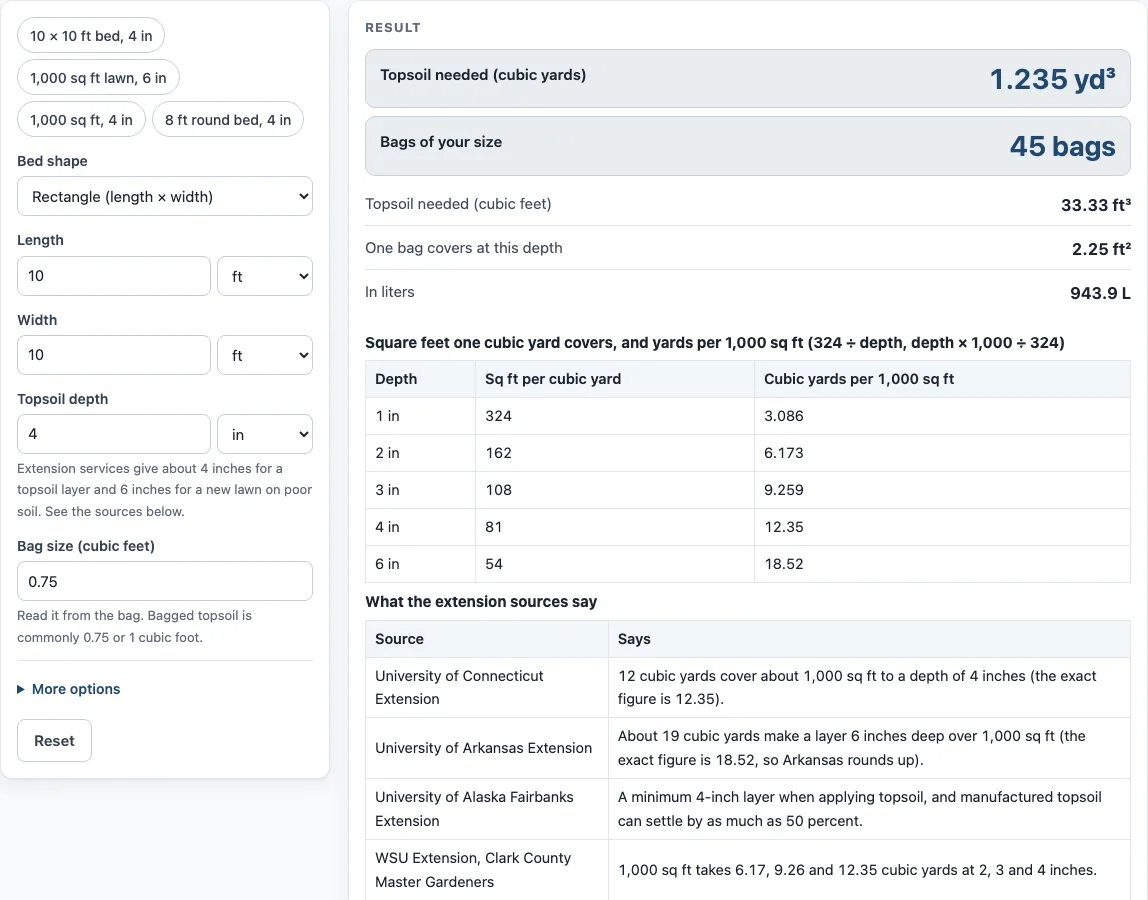
As a worked example, take a 10 ft × 10 ft area at 4 inches. The area is 100 square feet, and 4 inches is one third of a foot, so the volume is 33.33 cubic feet. Divide by 27 to get 1.235 cubic yards. Divided into 0.75 cubic foot bags, that is 44.4 bags, which rounds up to 45 bags.
What is the formula for cubic yards of topsoil?
The formula used for the volume check is cubic yards = depth in inches × area in square feet ÷ 324. University of Alaska Fairbanks Extension prints this rule. At 1,000 square feet and 6 inches, it gives 18.52 cubic yards.
Clark County WSU Master Gardeners list 6.17, 9.26 and 12.35 cubic yards per 1,000 square feet at 2, 3 and 4 inches. These match the formula exactly, so the page uses the same rule for any area.
Why do extension sources give different cubic yard figures?
University of Connecticut Extension says 12 cubic yards cover about 1,000 square feet to a depth of 4 inches. The exact figure is 12.35, so the Connecticut figure is a rounded value. University of Arkansas Extension says about 19 cubic yards make a 6-inch layer over 1,000 square feet. The exact figure is 18.52, so Arkansas rounds up.
The page shows 18.52 and names both sources, so you can see the exact figure and the rounded one side by side. The fixed tables on the page list cubic yards per 1,000 square feet at 1, 2, 3, 4 and 6 inches, along with the square feet one cubic yard covers.
How many bags make up a cubic yard of soil?
A cubic yard is 27 cubic feet. With 0.75 cubic foot bags, one cubic yard is 36 bags, and with 1 cubic foot bags it is 27 bags. The number you actually buy is always rounded up to a whole bag.
Bag sizes vary by maker, so the bag size field is yours to type. Check the volume printed on your bag before you rely on the bag count.
Does topsoil settle after it is spread?
Yes, it can. Alaska Extension advises applying a minimum 4-inch base layer of topsoil, and notes that manufactured topsoil can settle by as much as 50 percent. Because of this, the page always shows a settling warning.
The “extra percent for settling” field adds a margin to the volume. It is 0 by default, so enter a figure only if you want to allow for settling. The result is calculated from the number you type, not from a measured settling rate for your soil.
Sources (checked 15 October 2026): uaf.edu · homegarden.cahnr.uconn.edu · uaex.uada.edu · s3.wp.wsu.edu
Worked examples
| Input | Result |
|---|---|
| 10 ft × 10 ft, 4 in deep | 33.33 cubic feet (1.235 cubic yards), 45 bags of 0.75 cubic feet |
| 16 ft × 4 ft, 4 in deep | 21.33 cubic feet (0.7901 cubic yards), 22 bags of 1 cubic feet |
| round, 6 ft across, 3 in deep | 7.069 cubic feet (0.2618 cubic yards), 10 bags of 0.75 cubic feet |
| 500 ft², 6 in deep | 250 cubic feet (9.259 cubic yards), 334 bags of 0.75 cubic feet |
| triangle 3 m base, 2 m high, 10 cm deep | 10.59 cubic feet (0.3924 cubic yards), 11 bags of 1 cubic feet |
Calculated by the tool above; open it with the same values to see each step.
Frequently asked questions
Can I use it to estimate loam or garden soil?
It calculates the volume of garden and lawn topsoil for the area and depth you enter, so the volume answer applies to loam or garden soil of that depth. It is not a fill dirt estimator.
How much soil do I need for a 10 by 10 area?
For a 10 ft × 10 ft area at 4 inches, the calculation gives 1.235 cubic yards, or 45 bags of 0.75 cubic feet.
Is topsoil the same as fill dirt?
No. This tool is for garden and lawn topsoil, not fill dirt. Use a different estimate if you are filling a low spot or building up grade.
Can I use it for several beds?
Yes. Type “Number of identical areas” for beds of the same size. If your beds differ, add their areas first and use “I already know the area”.
Why does the page warn me about the depth or bag size?
A depth over 24 inches or under 1 inch, or a bag size under 0.1 or over 10 cubic feet, triggers a warning. These are checks on unusual values, so look at your numbers again if you see one.
Does the page upload my numbers or need an account?
No. Everything runs in your browser, nothing is uploaded, and no sign-up is needed. The tool is free to use.
Why do I see an error instead of a result?
An error appears when a size is blank, zero, negative or not a number, or when the number of areas is a fraction. Correct the field and the result will show.
Related tools
- Compost calculator: use it when you are working out how much compost to add to a bed.
- Sod calculator: use it if you are laying sod instead of seeding.
- Grass seed calculator: use it to plan seed for the lawn once the topsoil is down.
- Garden materials calculators: use it to see the other soil, compost and mulch tools.
- Mulch calculator: use it when you are estimating mulch for the same beds.
- Raised bed soil calculator: use it when you are filling a raised bed with soil.