
Stair Stringer Calculator
Enter the rise, tread depth and stair width to get the stringer length, the throat left in a 2x12, how many stringers to cut and where to mark the board.
Recent
Your last 10 settings, saved only in this browser. Nothing is uploaded.
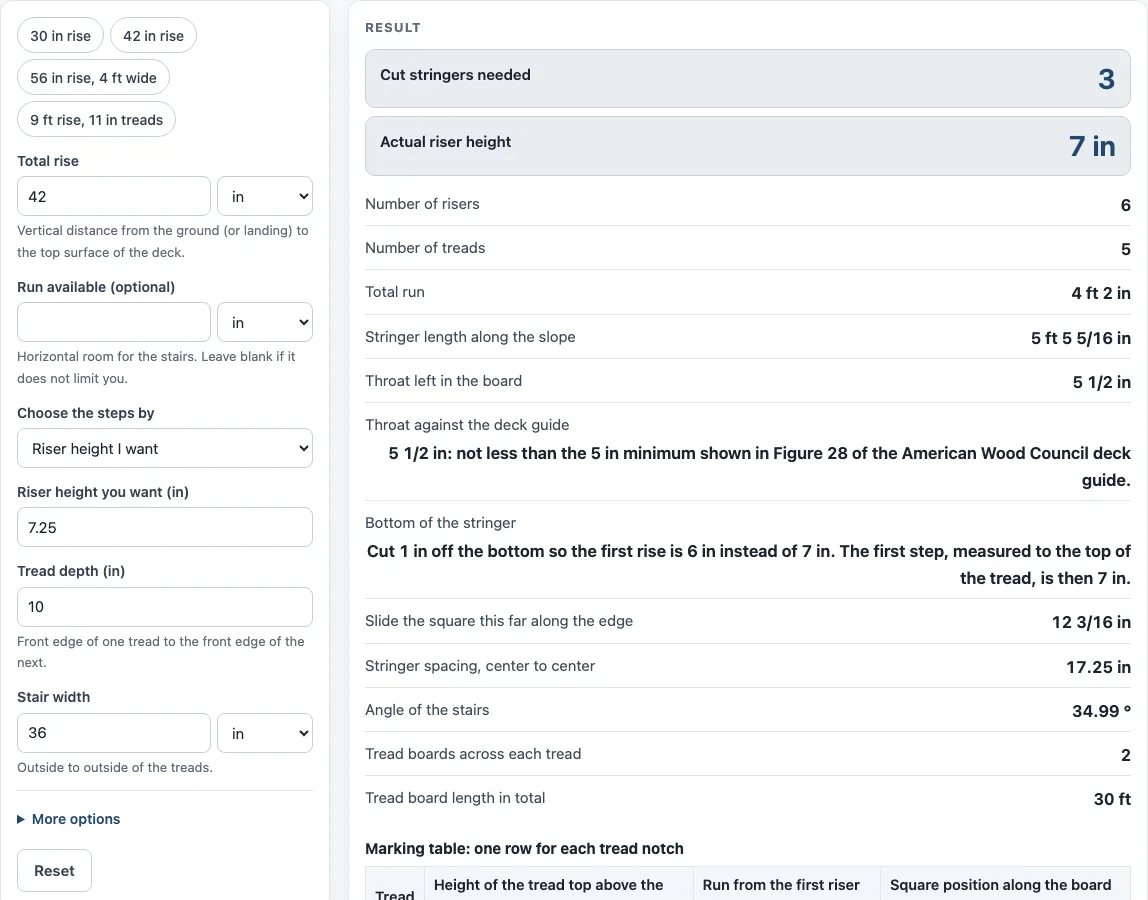
How to use the stair stringer calculator
- Type “Total rise”, the height the stairs must climb. Choose its unit: in, ft, cm or m.
- Under “Choose the steps by”, pick “Riser height I want” or “Number of risers”, then type “Riser height you want (in)” or “Number of risers”.
- Type “Tread depth (in)”.
- Optionally, type “Run available (optional)”. If the run needed is longer, the page shows a tread depth that fits with the same risers.
- Type “Stair width”. It has its own unit, and a width under 36 in triggers a warning.
- Open “More options” and check “Stringer board” (2 × 12 or 2 × 10), “Tread boards” (5/4 or 2x), “Nosing projection (in)” and “Gap between tread boards (in)”.
- Read the results, from the risers and total run to the throat, cut stringers needed and bottom of the stringer.
- Use the marking table, one row for each tread notch. Each row gives the tread top height, the run from the first riser face and the square position along the board edge.
- Read any warnings. They cover a throat under 5 in, a 2 × 10, a run over 6 ft, a width under 36 in, a rise above 144 in, and a riser or tread outside the 2021 IRC figures. With fewer than 2 risers there is no notch to cut, so an error appears.
Check the board choices before you read the cut marks, since they change the throat.
How to cut stair stringers for deck stairs
To cut stair stringers, first divide the total rise into equal risers, then mark each tread on a stringer board with a framing square. The tool does both steps from your inputs and gives you the marks. The sections below explain the formulas behind the layout and the sizes cited in the sources it uses.
What the stringer layout formulas mean
The riser is the total rise divided by the number of risers. The number of treads is one less than the number of risers, because the top of the deck is the last level. The run is the number of treads times the tread depth, and the stringer length is the square root of the rise squared plus the run squared.
The throat is the depth of board left under the notch. It equals the board depth minus the riser times the tread divided by the square root of the riser squared plus the tread squared. A 2 x 12 is 11 1/4 in deep and a 2 x 10 is 9 1/4 in deep, using the American Softwood Lumber Standard PS 20-20 Table 3.
The bottom cut removes the tread thickness from the bottom riser: 1 in for 5/4 boards and 1 1/2 in for 2x boards, using PS 20-20. This makes the first step, measured to the top of the tread, match the others. The code text measures risers between the leading edges of adjacent treads.
The number of cut stringers is at least three and no more than 18 in on center, from the formula max(3, ceil((width - 1 1/2 in) / 18) + 1). The AWC DCA 6 deck guide (2015 IRC edition, Figure 28) shows 5 in as the minimum throat under a cut stringer, a maximum span of 6 ft, and a minimum board of 2 x 12. Its commentary analyses a 5.1 in depth at a 7.75 : 10 rise to run, which this layout reproduces at 5.12 in.
Which deck stairs code figures apply
The 2021 IRC model text states a riser of not more than 7 3/4 in and a tread of not less than 10 in. Some states amend them. Virginia, for example, uses 8 1/4 in and 9 in. Check your local code and permit rules, because a deck stairs code can differ from the model figures. This page states what the cited sources say and does not call a layout compliant.
Sources (checked 15 October 2026): web-media.awc.org · nist.gov · up.codes
Worked examples
| Input | Result |
|---|---|
| 42 in rise, 10 in treads, 36 in wide | 6 risers of 7 in, 3 stringers, throat 5 1/2 in |
| 30 in rise, 11 in treads, 48 in wide | 4 risers of 7 1/2 in, 4 stringers, throat 5 1/16 in |
| 56 in rise, 10 in treads, 4 ft wide | 8 risers of 7 in, 4 stringers, throat 5 1/2 in |
| 8 ft rise, 10.5 in treads, 36 in wide | 13 risers of 7 3/8 in, 3 stringers, throat 3 3/16 in |
Calculated by the tool above; open it with the same values to see each step.
Frequently asked questions
How do I cut stair stringers for deck stairs?
Set your rise, riser and tread in the tool, then use the marking table. Place your framing square on the stringer board at each row, using the run and the distance along the board edge shown there. The “Bottom of the stringer” result tells you how much to cut off the bottom so the first step matches the others.
What throat depth should a stringer have?
The DCA 6 guide (2015 IRC edition, Figure 28) shows 5 in as the minimum throat under a cut stringer, and the page warns if your throat is under 5 in. A 2 x 12 is 11 1/4 in deep and a 2 x 10 is 9 1/4 in deep, so the board you choose affects the throat.
How many stringers does a deck stair need?
The calculator uses at least three cut stringers and no more than 18 in on center. Wider stairs get more stringers. The DCA 6 guide sets a minimum stair width of 36 in for this layout.
Can I use a 2 x 10 for deck stringers?
The page warns when you choose a 2 x 10. The DCA 6 guide says all stringers shall be a minimum of 2 x 12, so check your local code and permit rules before using a 2 x 10.
Are these riser and tread sizes the same as the deck stairs code?
The 2021 IRC model text states a riser of not more than 7 3/4 in and a tread of not less than 10 in. Some states amend them, so the figures that apply where you build may differ. Check local code and permit rules.
What if my deck run is longer than 6 ft?
The page warns when the run is over 6 ft. The DCA 6 guide describes a post under the stringer or an intermediate landing for longer runs. Check local code before you decide on a layout.
Related tools
- Deck Stair Calculator: use it to work out risers, treads, run and angle for deck stairs.
- Deck and stair calculators: use it to see every deck and stair tool in one place.
- Deck Board Calculator: use it to count the deck boards for a deck surface.
- Deck Board Dimensions: use it to compare the sizes of deck boards before you buy.
- Deck Joist Spacing Chart: use it to check joist spacing for the deck frame.
- Cost to Build a Deck Calculator: use it to estimate what a deck will cost, using prices you type.
- Deck Stain Calculator: use it to work out how much stain a deck needs.