
Square foot gardening chart and planner
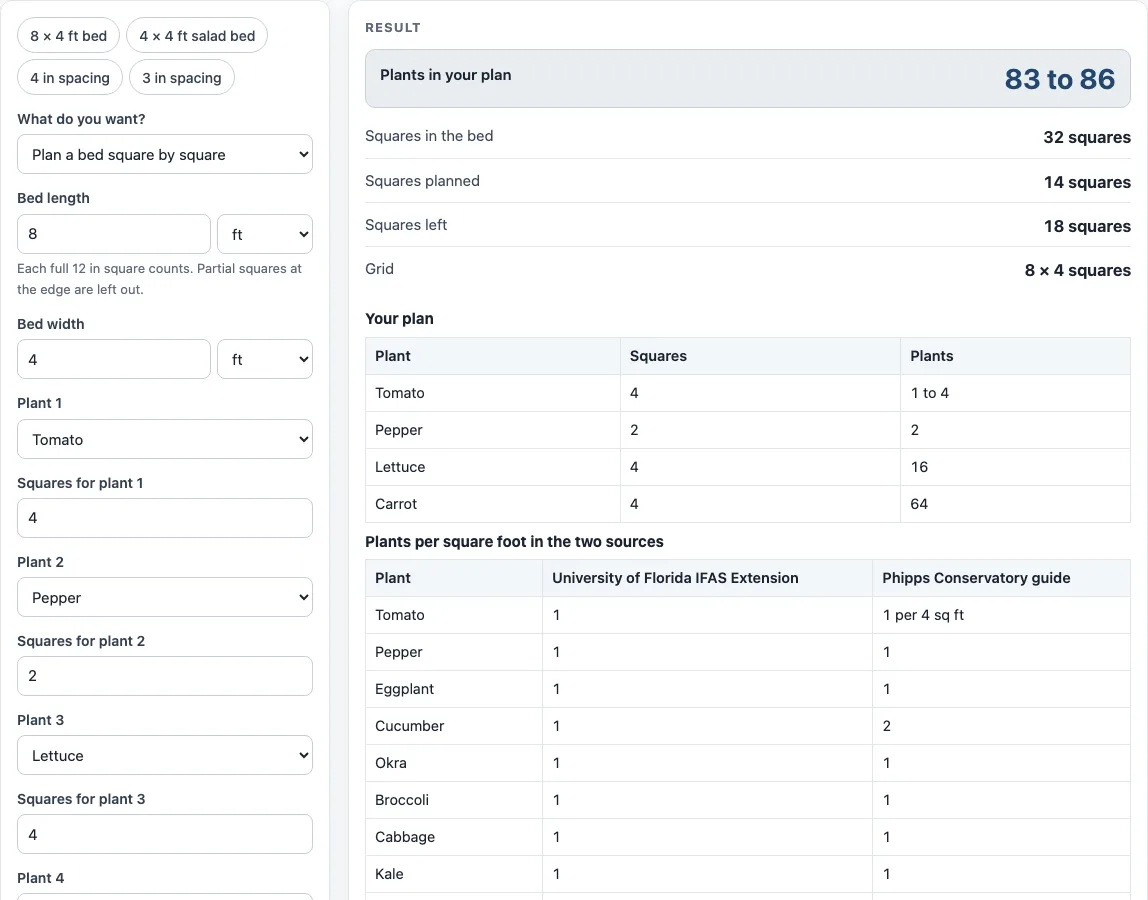
Pick your plants and give each some squares. You get the plants in your plan, the squares used and the squares left.
Recent
Your last 10 settings, saved only in this browser. Nothing is uploaded.
This square foot gardening chart shows how many plants fit in one 12 in × 12 in square for 34 vegetables and herbs, and its planner lays out a whole bed square by square. Use it to plan your bed before you buy seeds or plants, and to compare what two public sources say for each crop.
The chart draws on two public sources, the University of Florida IFAS Extension square foot gardening page and the Phipps Conservatory guide (2020). Where those sources disagree, both figures appear, so you can see the range. It runs in your browser, is free, needs no sign-up, and nothing you type is uploaded. Results are calculated from your inputs.
How to use the Square Foot Gardening Chart and Planner
- Under “What do you want?”, keep “Plan a bed square by square”. Type “Bed length” and “Bed width” in feet, inches, meters or centimeters. The planner counts only full 12 in squares, so an 8 ft × 4 ft bed gives 32 squares.
- Pick up to five plants in “Plant 1” to “Plant 5”.
- For each plant, type its “Squares for plant” number. Use whole numbers only.
- Read “Plants in your plan”. This is a range: squares × the lowest figure the two sources give, up to squares × the highest figure, rounded down to whole plants.
- Check “Squares in the bed”, “Squares planned”, “Squares left” and “Grid” to see how much of the bed the plan fills.
- Read any warning. A warning appears when the plan uses more squares than the bed has, when squares are entered with no plant chosen, and when the bed is under 1 ft in either direction.
- Change the square counts until the plan fits the bed.
- To check a spacing you already know, choose “Plants per square for a spacing” and type “Space between plants (inches)”. “Plants per square” equals the whole part of 12 ÷ spacing, squared. A spacing of 12 in gives 1 per square, and 6 in gives 4. Spacings over 12 in take a block of squares, so 24 in needs 4 squares per plant, shown under “What that means”.
Zero or negative sizes, negative or fractional square counts, and non-numeric entries show an error instead of a result.
How many plants fit in one square foot?
Each 12 in × 12 in square holds a count taken from the two public sources, not from a single fixed rule. The chart lists 34 vegetables and herbs, and it reproduces the figures from the University of Florida IFAS Extension and Phipps Conservatory guides. The method was developed by Mel Bartholomew, but this page does not reproduce his book’s tables.
The sources do not always agree. Beets are 9 per square in one source and 16 in the other, onions are 16 and 9, spinach is 4 and 9, and tomatoes are 1 per square against 1 per 2 ft × 2 ft block. The chart shows both figures for these crops. Crops that need more than one square are stored as fractions: tomato is 0.25 per square (one per 2 ft × 2 ft block), and summer squash is 1/9 per square (one per 3 ft × 3 ft block).
The plant total in the planner follows from those figures. For example, 3 squares of beets give 27 plants at 9 per square or 48 at 16 per square. The planner shows the full span, so a plan is never presented as one exact number.
How does the spacing formula work for a square foot garden?
The spacing mode uses one formula: plants per square = floor(12 ÷ spacing in inches), squared. At 12 in spacing the result is 1 per square. At 6 in it is 4, at 4 in it is 9, and at 3 in it is 16.
When 12 does not divide evenly by the spacing, the count rounds down. At 5 in spacing, 12 ÷ 5 is 2.4, which rounds down to 2 per row and 2 per column, so the result is 4 per square. A warning tells you this has happened. For spacings over 12 in, the plant takes a block of squares instead. At 24 in spacing, each plant needs 2 × 2 = 4 squares.
The planner also works in whole squares. Partial squares at the edges of a bed are not counted. An 8 ft × 4 ft bed holds 32 squares. In the worked example, 4 squares of tomato, 2 of pepper, 4 of lettuce and 4 of carrot use 14 of those 32 squares and hold 83 to 86 plants, as calculated from the two sources’ figures.
Sources (checked 15 October 2026): gardeningsolutions.ifas.ufl.edu · phipps.conservatory.org
Worked examples
| Input | Result |
|---|---|
| 8 × 4 ft bed, 32 squares | 14 squares planned, 83 to 86 plants |
| 4 × 4 ft bed, 16 squares | 6 squares planned, 48 plants |
| 2.4 × 1.2 m bed, 21 squares | 14 squares planned, 83 to 86 plants |
| 4 in spacing | 9 per 12 in square |
| 24 in spacing | Oversize plant: give it 4 squares (a block) |
Calculated by the tool above; open it with the same values to see each step.
Frequently asked questions
What is a square foot gardening chart?
It is a reference that lists how many plants of each crop fit in one 12 in × 12 in square. This page covers 34 vegetables and herbs and includes a planner for whole beds.
Why do the two sources give different numbers?
The Florida and Phipps sources set different spacing guidance for some crops, such as beets and onions. The page shows both figures, so the plant total is a range.
Does the chart cover companion planting?
No. The chart gives plant counts per square. It does not list which crops grow well together.
Why does the planner count only full squares?
It counts only full 12 in squares, so partial squares at the bed edges are left out. An 8 ft × 4 ft bed is counted as 32 squares.
Why did my plan show a warning?
A warning appears if the plan uses more squares than the bed has, if squares are entered with no plant, or if the bed is under 1 ft in either direction.
Which units can I use for the bed size?
Feet, inches, meters or centimeters. The tool counts only the full 12 in squares that fit.
Is my bed data uploaded anywhere?
No. Everything runs in your browser, nothing is uploaded, and no sign-up is needed.
Related tools
- Garden bed and patio planning: use it to see the other tools for planning an outdoor space.
- Plant spacing calculator: use it when you want spacing advice for a crop outside a square-by-square layout.
- Raised bed soil calculator: use it to estimate how much soil a raised bed needs.
- Compost calculator: use it to work out how much compost to add to your beds.
- Patio umbrella size chart and calculator: use it when you are planning shade for a seating area near the garden.
- Pergola cost calculator: use it when you are considering a pergola alongside your garden layout.