
Sonotube Sizes
Pick a round form size and the concrete height to see the volume in one tube, with the maker chart beside the geometry and the smallest tube for your footing diameter.
Recent
Your last 10 settings, saved only in this browser. Nothing is uploaded.
How to use the Sonotube Sizes tool
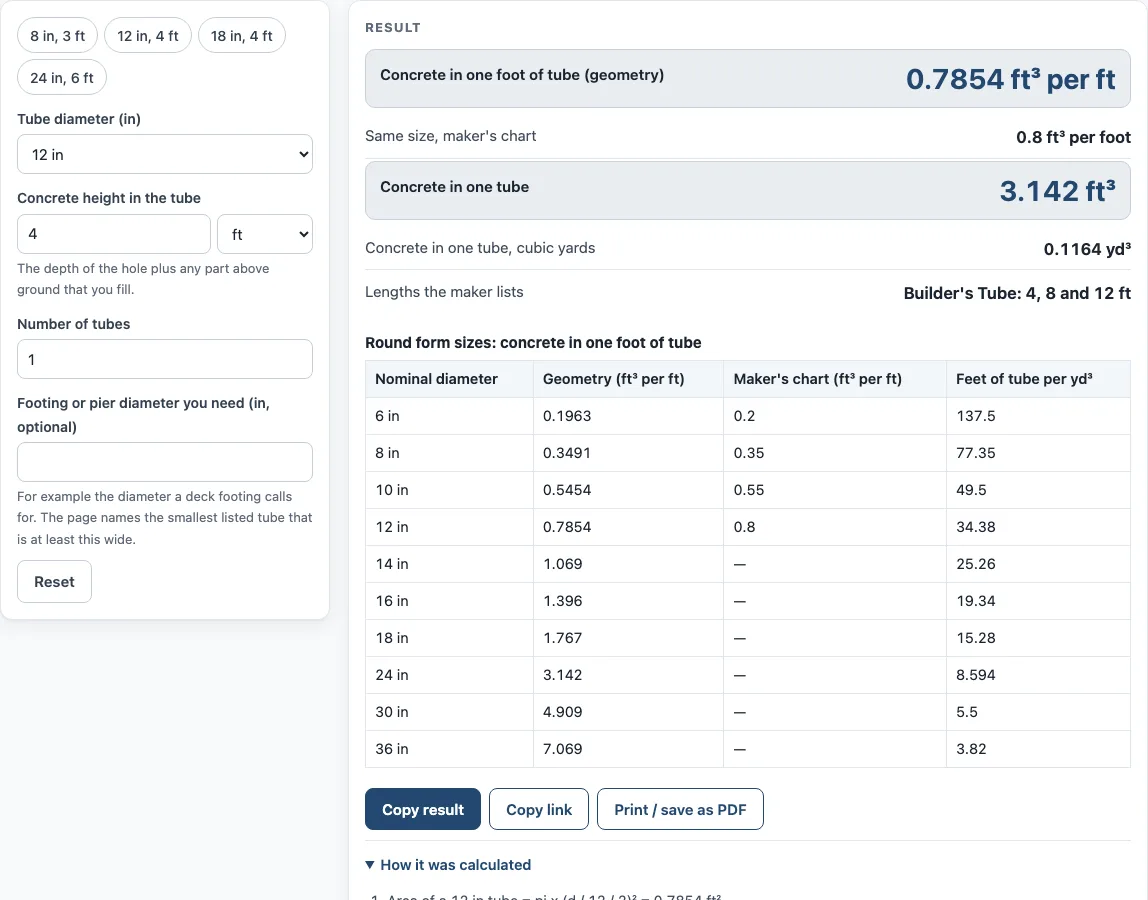
- Open the “Tube diameter (in)” list and choose 6, 8, 10, 12, 14, 16, 18, 24, 30 or 36 in.
- Type the depth of concrete you plan to pour into “Concrete height in the tube”. Choose the unit: in, ft, cm or m.
- Enter the number of tubes in “Number of tubes”. This must be a whole number.
- Optional: type the width you need in “Footing or pier diameter you need (in, optional)”. For example, 15 in shows the 16 in tube, the smallest listed size at least that wide.
- Read “Concrete in one foot of tube (geometry)” for the calculated figure.
- Read “Same size, maker’s chart” if your size is 6, 8, 10 or 12 in.
- Check “Concrete in one tube” and “Concrete in one tube, cubic yards”.
- If you entered more than one tube, read “Concrete in all tubes” and its cubic yards.
- Check “Smallest tube for your diameter” and “Lengths the maker lists”.
- Compare all ten sizes in the table “Round form sizes: concrete in one foot of tube”, which shows feet of tube per cubic yard.
The four presets fill the controls with 8 in and 3 ft, 12 in and 4 ft, 18 in and 4 ft, or 24 in and 6 ft. A blank, zero or non-numeric height shows an error. A height over 12 ft shows a warning about lengths.
What does the concrete per foot number on this page mean?
The concrete per foot number is the volume of one foot of tube, in cubic feet. It equals the cross-sectional area of the nominal diameter in square feet, because one foot of length multiplies the area by one.
The page calculates the area with the formula pi × (d ÷ 12 ÷ 2)², where d is the diameter in inches. Dividing by 12 converts inches to feet, and dividing by 2 gives the radius. The calculation uses the nominal diameter and ignores wall thickness. The maker’s sheet makes the same point: “Diameter sizes are nominal. If critical, you need to measure.”
The maker chart and the geometry give slightly different figures. The chart gives 0.20, 0.35, 0.55 and 0.80 cubic feet per foot for 6, 8, 10 and 12 in. The geometry gives 0.196, 0.349, 0.545 and 0.785. For 12 in the two figures differ by about 0.015 cubic feet per foot. The page shows both values instead of averaging them.
How is the concrete volume in a tube worked out?
The volume in one tube is the concrete per foot multiplied by the height in feet. To convert cubic feet to cubic yards, divide by 27, because one cubic yard holds 27 cubic feet.
For example, a 12 in tube filled to 4 ft holds 0.7854 cubic feet per foot, which gives 3.142 cubic feet in the tube. Dividing by 27 gives 0.1164 cubic yards. For several tubes, multiply the single-tube volume by the number of tubes. Six 8 in tubes with 3 ft of concrete each hold 1.047 cubic feet, or 6.283 cubic feet (0.2327 cubic yards) in total.
Sources (checked 19 October 2026): es-la.sonoco.com · es-la.sonoco.com
Worked examples
| Input | Result |
|---|---|
| 12 in tube, 4 ft of concrete, 1 tube(s) | 3.142 ft³ (0.116 yd³) of concrete |
| 8 in tube, 3 ft of concrete, 6 tube(s) | 6.283 ft³ (0.233 yd³) of concrete |
| 18 in tube, 4.921 ft of concrete, 1 tube(s) | 8.697 ft³ (0.322 yd³) of concrete |
Calculated by the tool above; open it with the same values to see each step.
Frequently asked questions
Which sonotube sizes are listed on the page?
The page lists ten sizes: 6, 8, 10, 12, 14, 16, 18, 24, 30 and 36 in. The maker’s brochure lists commercial forms from 6 to 60 in, so the 14 to 36 in sizes sit inside that range. Which sizes a yard stocks varies, and the page does not claim any stock.
Can these forms be used above ground?
The 6 to 12 in forms are made for below-ground placement and can be used up to 3 ft above the ground line. Minimal bracing is required above 2 ft of ground line. They are single-use and should not be used with mechanical vibrators.
What if my footing is wider than the largest tube?
Enter a diameter over 36 in and the page shows a warning instead of a tube size. The largest listed size is 36 in.
What happens if the concrete height is very tall?
A height over 12 ft shows a warning that the smaller forms are sold in 12 ft or shorter lengths. For 6 to 12 in forms, the maker lists standard lengths of 4, 8 and 12 ft.
Does the page show bag counts or prices?
No. The results give cubic feet and cubic yards only. No prices are built in or asked for.
Is my data sent anywhere?
The tool runs entirely in your browser, and nothing is uploaded. There is no sign-up, and the tool is free to use.
Related tools
- Deck Footing Calculator: use it when you are planning the footings that the concrete tubes will form.
- Cost to Build a Deck Calculator: use it to estimate the overall cost of a deck project.
- Deck Board Calculator: use it to work out how many deck boards a deck surface needs.
- Deck Ledger Board: use it when the deck attaches to the house and you want the ledger fastener spacing the AWC guide lists.
- Deck Railing Height: use it to see what the code texts say about guard height for the same deck.