
Raised bed soil calculator
Enter the size of your bed or pot, its depth and your bag size. You get the soil in cubic feet, cubic yards and bags, split by your mix.
Recent
Your last 10 settings, saved only in this browser. Nothing is uploaded.
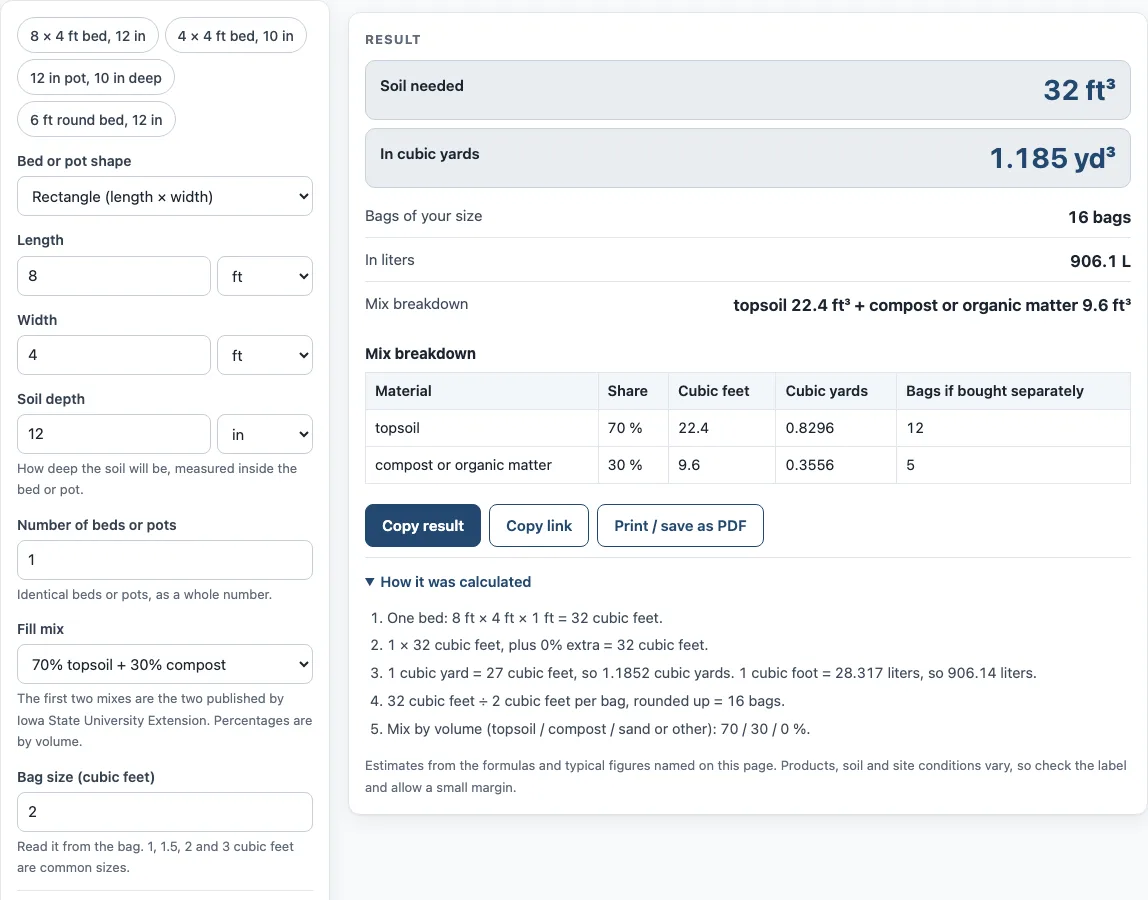
How to use the Raised Bed Soil Calculator
- Under “Bed or pot shape”, choose “Rectangle (length × width)” or “Round bed or pot (diameter)”.
- Type “Length” and “Width” for a rectangle, or “Diameter” for a round bed or straight-sided pot. Each figure has its own unit: feet, inches, meters or centimeters.
- Type “Soil depth”, the depth you plan to fill, measured inside the bed or pot. It has its own unit and starts at 12 in.
- Type “Number of beds or pots” as a whole number.
- Type “Bag size (cubic feet)” from the bag label. Common sizes are 1, 1.5, 2 and 3 cubic feet.
- Under “Fill mix”, choose “70% topsoil + 30% compost”, “Equal parts topsoil, organic matter, coarse sand”, “One material (for example bagged potting mix)” or “My own percentages”.
- For your own percentages, fill in “Topsoil (%)”, “Compost or organic matter (%)” and “Coarse sand or other (%)”. A warning appears if they do not add up to 100.
- If the soil will settle, type a few percent in “Extra for settling (%)”. It starts at 0.
- Read “Soil needed” in cubic feet, then “In cubic yards”, “In liters”, “Bags of your size” and “Per bed or pot”.
- Read the “Mix breakdown” table, which lists each material’s share, volume and bags if bought separately.
If a field is blank, zero, negative or not a number, or the number of beds is fractional, an error appears instead of a result. A warning also appears if a dimension is over 100 ft or the bag size is under 0.1 or over 10 cubic feet.
How is the soil volume for a raised bed calculated?
The volume of a rectangular bed is length × width × depth. A round bed or straight-sided pot uses π × (diameter ÷ 2)² × depth, so the diameter is halved to find the radius before squaring it. The calculator converts every unit you choose before it multiplies.
Results come out in cubic feet, cubic yards and liters. One cubic yard equals 27 cubic feet, and one cubic foot equals 28.317 liters. Keep the depth in mind when you plan. Iowa State University Extension advises adding the mix a few inches at a time and working it into the existing soil, so the depth you type is the depth you intend to fill, not a fixed standard.
For example, an 8 ft × 4 ft bed filled 12 in deep holds 32 cubic feet, which is 1.185 cubic yards. A round bed 4 ft across and 1 ft deep holds 4 × π, or 12.57 cubic feet. Four 12 in pots filled 10 in deep take 0.6545 cubic feet each, or 2.618 cubic feet in total.
How many bags of soil do I need for a raised bed?
Divide the volume of each material by the bag size, then round up to the next whole bag. The fill mix is set by volume, so each material’s share of the total is measured in cubic feet before it is converted to bags.
The first preset is about 70% topsoil and 30% compost. For the 8 ft × 4 ft bed above, that is 22.4 cubic feet of topsoil and 9.6 cubic feet of compost. With 2 cubic foot bags, the total of 32 cubic feet needs 16 bags. The second preset uses equal parts topsoil, organic matter and coarse sand, and it is also based on volume. The round bed example needs 12.57 cubic feet, which is 7 bags of 2 cubic feet.
The calculator gives no weight guide. The pound-per-cubic-foot figures found for bagged mixes and compost disagree widely, and none came from an extension or government source, so weight is left out.
Sources (checked 15 October 2026): yardandgarden.extension.iastate.edu
Worked examples
| Input | Result |
|---|---|
| 1 × 8 ft × 4 ft, 12 in deep, 70% topsoil + 30% compost | 32 cubic feet (1.185 cubic yards), 16 bags of 2 cubic feet |
| 2 × 6 ft × 3 ft, 10 in deep, Equal parts topsoil, organic matter, coarse sand | 30 cubic feet (1.111 cubic yards), 20 bags of 1.5 cubic feet |
| 1 × round, 4 ft across, 1 ft deep, One material (for example bagged potting mix) | 12.57 cubic feet (0.4654 cubic yards), 7 bags of 2 cubic feet |
| 4 × round, 12 in across, 10 in deep, One material (for example bagged potting mix) | 2.618 cubic feet (0.09696 cubic yards), 3 bags of 1 cubic feet |
| 1 × 2.4 m × 1.2 m, 30 cm deep, My own percentages | 32.04 cubic feet (1.187 cubic yards), 17 bags of 2 cubic feet |
Calculated by the tool above; open it with the same values to see each step.
Frequently asked questions
Does this raised bed soil calculator work for pots?
Yes. For a round or straight-sided pot, use the diameter and the depth, and enter the number of pots. The result shows the volume for a single pot when there is more than one.
Can I use it as a potting mix calculator?
Yes. Choose a single material, such as bagged potting mix, and the bag count follows from the volume and bag size you enter.
Is this the right tool for bulk dirt or fill?
No. This page covers beds and pots only. For bulk topsoil or fill in yards, use the Topsoil calculator.
How do I calculate soil for a raised bed with my own mix?
Under “Fill mix”, choose “My own percentages” and enter the share for each material. They should total 100. The “Mix breakdown” table then shows each material’s cubic feet and bag count.
Why does my result show a warning?
A warning appears if your custom percentages do not total 100, if a dimension is over 100 ft, which often means a unit mix-up, or if the bag size is under 0.1 or over 10 cubic feet. Check the flagged figure and run the calculation again.
Does the calculator tell me how much the soil weighs?
No. It gives volume and bag counts only, because the weight figures available disagree widely.
Related tools
- Topsoil calculator: Use it for bulk topsoil or fill measured in cubic yards.
- Garden materials calculators: Use it to see the other soil, compost and mulch tools.
- Compost calculator: Use it to work out compost quantities when you are planning a soil mix.
- Plant spacing calculator: Use it to plan how many plants fit across a bed once it is filled.
- Square foot gardening chart: Use it to lay out a bed in square-foot sections.
- Patio umbrella size chart: Use it to check umbrella sizes for a patio near your garden.
- Pergola cost calculator: Use it to estimate costs for a pergola project.