
Paver Sand Calculator
Enter the paved area and the thickness of the bedding layer to see cubic feet, cubic yards, tons and bags of sand, and how many bags of joint sand to sweep into the joints.
Recent
Your last 10 settings, saved only in this browser. Nothing is uploaded.
How to use the paver sand calculator
- Choose the shape of your area: rectangle, circle, triangle, or a known total area.
- Pick feet or meters, then enter your measurements. Blank, zero, negative or non-numeric values show an error message instead of a result.
- Check the area shown in square feet and square meters to confirm the size is right.
- Set “Bedding sand thickness (in)”. It defaults to 1 in. A warning appears if you go below 3/4 in or above 1 1/2 in.
- Leave “Sand weight (lb per ft³)” at 100, or edit it if you have a better figure for your sand. Wet sand weighs more.
- Leave “Bedding sand bag size (ft³)” at 0.5, or edit it to match the bags you plan to buy.
- Under “Joint sand”, pick “Bedding sand only”, “Narrow joints (polymeric sand)”, “Wide joints (polymeric sand)” or “My bag’s coverage (type it)”. It starts on narrow joints.
- If you chose your own coverage, type the figure from your bag label into “Coverage of a 50 lb bag (ft²)”. If your bag weighs something other than 50 lb, edit “Joint sand bag weight (lb)”. Coverage scales with it.
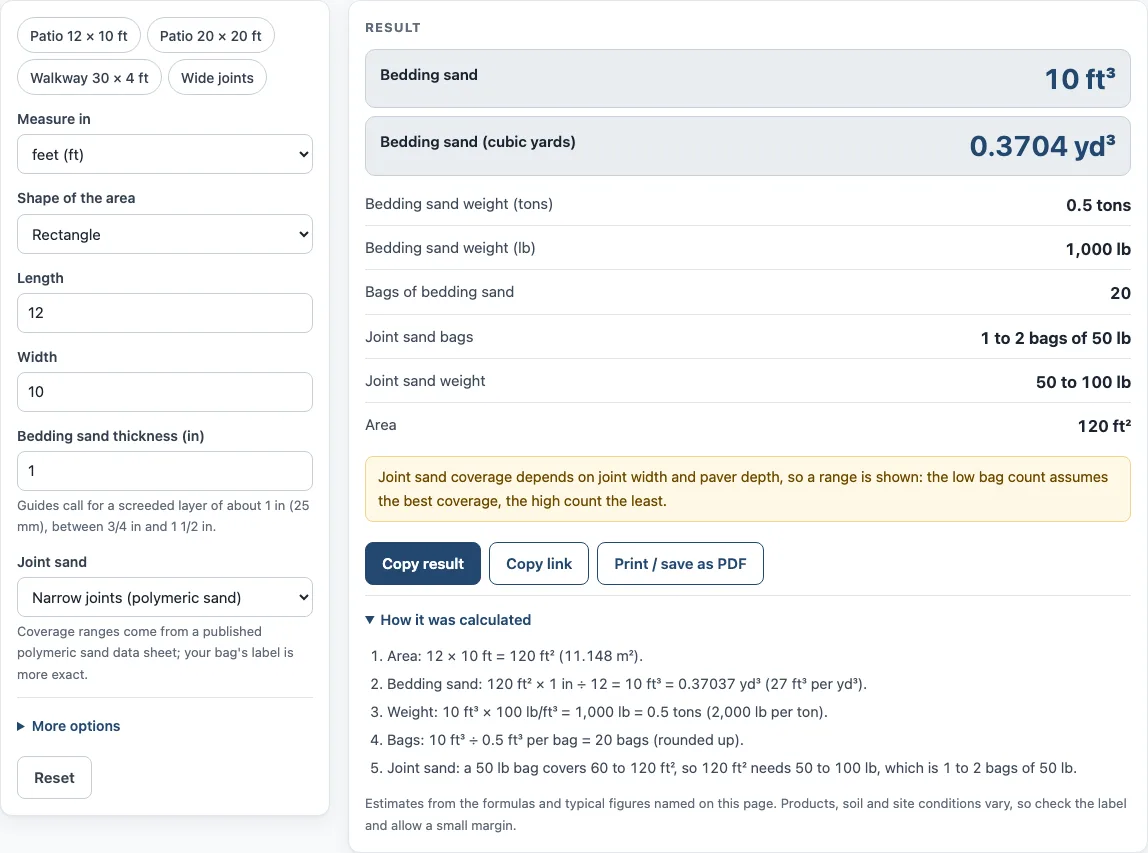
- Read the results: cubic feet, cubic yards, pounds, tons, and bags of bedding sand, rounded up. Joint sand appears as a low-to-high range.
To size bedding sand and joint sand separately, run the tool with “Bedding sand only” first, then with a joint option, and compare the two sets of results.
How do you calculate paver sand?
The bedding sand volume is the area multiplied by the thickness, with the thickness converted from inches to feet. In cubic feet, volume = area in ft² × thickness in inches ÷ 12. Divide cubic feet by 27 to get cubic yards. For example, a 12 × 10 ft area is 120 ft². At 1 in, that gives 120 × 1 ÷ 12 = 10 ft³, or 0.3704 yd³.
Weight equals cubic feet multiplied by the sand weight per cubic foot. At the default of 100 lb/ft³, 10 ft³ weighs 1,000 lb, which is 0.5 ton, since a ton is 2,000 lb. Bags equal cubic feet divided by the bag size, rounded up. At 0.5 ft³ per bag, 10 ft³ needs 20 bags.
Area depends on the shape. A rectangle is length × width. A circle is π × radius², so a 12 ft round patio has a radius of 6 ft and an area of 113.1 ft². A triangle is one-half × base × height.
What bedding thickness and sand weight should you enter?
The bedding thickness defaults to 1 in. That is the screeded depth in the interlocking paver industry’s inspection checklist and in a state transportation department specification, which allows up to 1 1/2 in. The industry checklist sets 3/4 in as a minimum over a rigid base. The tool warns you below 3/4 in or above 1 1/2 in.
Sand weight also varies by listing. One bag listing implies 100 lb/ft³, since a 9 ft³ bag listed at about 900 lb works out to that figure. Another listing implies 111 to 133 lb/ft³. The tool uses 100 lb/ft³ by default, so edit the figure if your sand is heavier.
Joint sand is sized the same way. Bags equal area ÷ coverage per bag, and pounds equal area ÷ coverage × 50. The low count assumes the best coverage per bag, and the high count assumes the least. The tool uses the published figures of one manufacturer: 60 to 120 ft² per 50 lb bag for narrow joints and 25 to 40 ft² for wide joints. Other published figures disagree. For example, one source gives 30 to 60 ft² per 50 lb for 1/4 to 3/8 in joints. Because of this, the label on your bag is the better guide. Base gravel is not calculated on this page.
For example, a 20 × 20 ft area is 400 ft². At 1 in, that is 33.33 ft³, or 1.235 yd³, or 3,333 lb (1.667 tons), or 67 bags. With wide joint sand at 25 to 40 ft² per bag, you would need 10 to 16 bags of 50 lb, or 500 to 800 lb.
Sources (checked 15 October 2026): icpi.org · masonryandhardscapes.org · ia.iowadot.gov · techniseal.com · lowes.com
Worked examples
| Input | Result |
|---|---|
| 120 ft², 1 in bedding layer | 10 ft³ (0.3704 yd³, 0.5 tons) of bedding sand |
| 400 ft², 1 in bedding layer | 33.33 ft³ (1.235 yd³, 1.67 tons) of bedding sand |
| 113.1 ft², 1 in bedding layer | 9.425 ft³ (0.3491 yd³, 0.471 tons) of bedding sand |
| 215.3 ft², 1.25 in bedding layer | 22.42 ft³ (0.8305 yd³, 1.12 tons) of bedding sand |
| 400 ft², 1 in bedding layer | 33.33 ft³ (1.235 yd³, 1.67 tons) of bedding sand |
Calculated by the tool above; open it with the same values to see each step.
Frequently asked questions
How much paver sand do I need for a patio?
Enter the patio’s area and bedding thickness in the paver sand calculator, then read the cubic yards or bags from the results. The figure comes from your inputs, so it changes with the size and depth you enter.
What bedding sand thickness does the paver sand calculator use?
It defaults to 1 in, which is the screeded depth in the interlocking paver industry’s inspection checklist and a state transportation department specification. You can change it. A warning appears below 3/4 in or above 1 1/2 in.
How do I calculate paver sand for a circle?
Find the radius from the diameter, then use area = π × radius². A 12 ft round patio is 113.1 ft², which needs 9.425 ft³ of bedding sand at 1 in, or 19 bags of 0.5 ft³. Choose the circle option to have the tool do this for you.
How many pounds of paver sand are in a cubic yard?
At the default 100 lb/ft³, a cubic yard (27 ft³) weighs about 2,700 lb. Sand weight varies by listing, and wet sand weighs more, so edit the sand weight figure if you have a better number.
How much polymeric joint sand do I need?
Choose “narrow joints” or “wide joints” to get a low-to-high range in bags and pounds. For a 400 ft² area with wide joints, the range is 10 to 16 bags of 50 lb. Check the coverage on your own bag, since published figures disagree.
Does the paver sand calculator upload my measurements?
No. It runs in your browser, and nothing is uploaded. It is free and needs no sign-up. It does not calculate base gravel, so size that separately.
Related tools
- Paver Calculator: use it to work out how many pavers your area needs.
- Paver Patio Cost Calculator: use it to estimate what a paver patio project may cost.
- Flagstone (Flagging) Calculator: use it if you are laying flagstone rather than pavers.
- Paver Base Calculator: use it for the gravel base under the bedding sand, which this page does not calculate.
- Lawn Area Calculator: use it to measure the lawn area around your new patio.