
Paver Edging Calculator
Enter the patio size, how much of the edge needs no restraint and the length of one piece to get the feet of edging, the pieces and the spikes to buy.
Recent
Your last 10 settings, saved only in this browser. Nothing is uploaded.
How to use the Paver Edging Calculator
- Choose a shape in “Patio shape”: Rectangle, Circle or I know the distance around.
- For a rectangle, enter the “Patio length” and “Patio width”. Pick the unit (ft, in, m or cm) for each number.
- For a circle, enter the “Patio diameter”. If you already measured the edge, choose I know the distance around and enter “Distance around the patio” instead.
- If one side sits against the house or another wall, enter that side’s length in “Length that needs no edging (optional)”. It must be shorter than the distance around.
- Enter the “Length of one piece of edging (ft)” that matches the product you plan to buy.
- Set “Spike spacing (in)”. Values under 6 in or over 24 in trigger a warning.
- Read “Edging needed”, “Pieces to buy” and “Spikes at your spacing”.
- Check “Spike size in the guides” and “Where it goes” for the size and placement the sources describe.
- Scroll to the table “Spikes for … ft of edging, by each guide” to compare the Guide, What it says and Spikes columns.
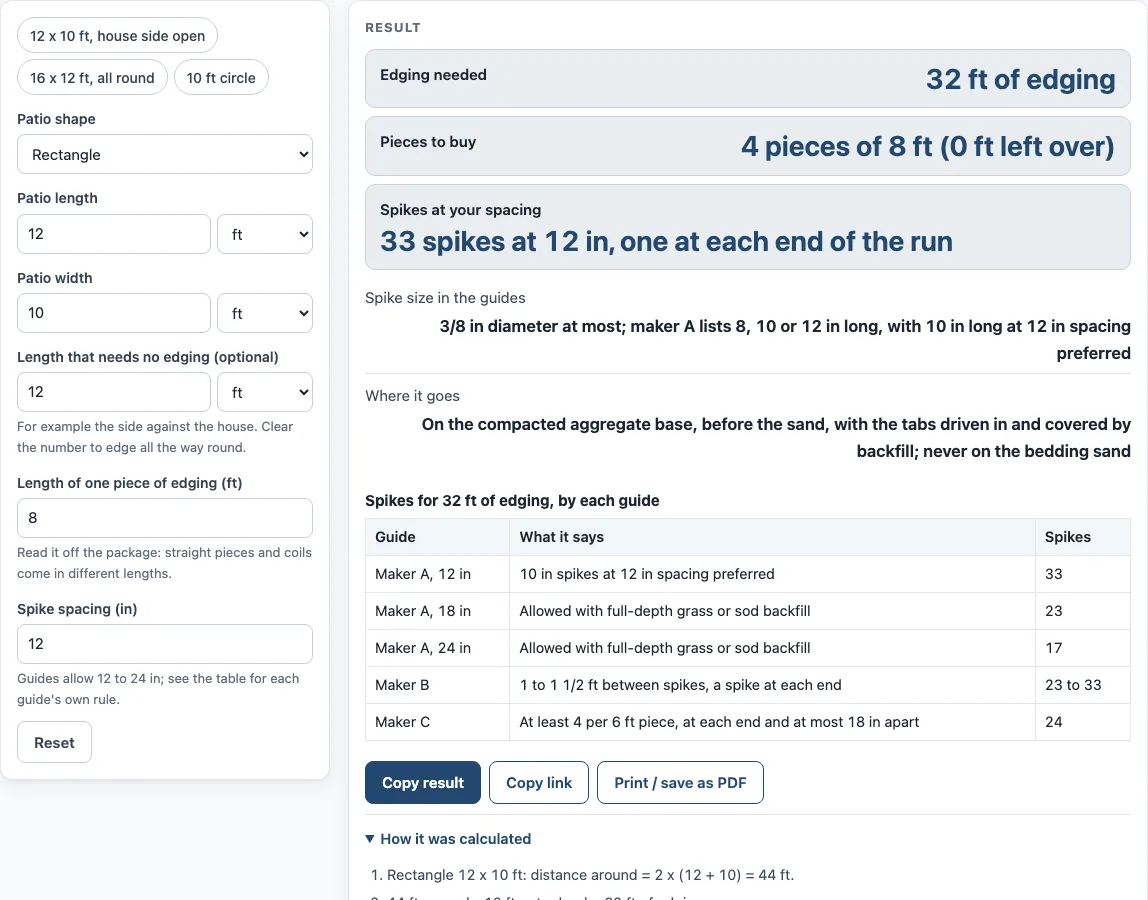
The three presets fill in common layouts: 12 x 10 ft with the house side open, 16 x 12 ft all round, and a 10 ft circle. A blank, zero or non-numeric value shows an error, so check each field before reading the results.
How much paver edging does a patio need?
Edging is the distance around the patio minus any length that needs no edging. For a rectangle, the distance around is 2 x (length + width). For a circle, it is pi x diameter. Pieces are the edging length divided by the piece length, rounded up.
Take a 12 x 10 ft patio with the 12 ft house side open. The distance around is 44 ft, so 32 ft needs edging. With 8 ft pieces, that is 4 pieces with nothing left over. A 10 ft circle has 31.42 ft around. With 20 ft pieces, you need 2 pieces, and 8.58 ft is left over.
How many spikes does paver edging need?
The spike count is the edging length in inches divided by the spike spacing, rounded up, plus 1. The extra spike gives one at each end of the run. The 32 ft edge at 12 in spacing gives 384 in / 12 = 32, plus 1, which is 33 spikes. At 18 in spacing, the same edge needs 23 spikes, and at 24 in it needs 17.
The three installer sheets do not agree on spacing, so the tool lists them separately rather than merging them:
- Maker A allows spacing from 12 to 24 in. It prefers 10 in spikes at 12 in spacing, and allows 18 or 24 in only with full-depth grass or sod backfill.
- Maker B recommends a distance of 1 to 1 1/2 feet between spikes, with a spike at each end of each piece.
- Maker C asks for at least 4 spikes per 6 ft piece and no more than 18 in apart.
Sizes vary by maker, so check the sheet for the product you are buying. Maker A and Maker C both say the edging should be covered by backfill so it is not visible. Edging goes on the compacted aggregate base, before the sand is screeded, with the tabs under or outside the pavers. It is never placed on the bedding sand.
Sources (checked 19 October 2026): westerninterlock.com · images.thdstatic.com · images.thdstatic.com
Worked examples
| Input | Result |
|---|---|
| 32 ft of edging, 8 ft pieces, spikes 12 in apart | 4 pieces and 33 spikes |
| 31.416 ft of edging, 20 ft pieces, spikes 18 in apart | 2 pieces and 22 spikes |
| 60 ft of edging, 6 ft pieces, spikes 12 in apart | 10 pieces and 61 spikes |
Calculated by the tool above; open it with the same values to see each step.
Frequently asked questions
What is paver edging?
Paver edging, also called edge restraint, is a strip held by spikes along the outside of a paver area. It keeps the pavers from spreading or shifting at the edges.
Does this calculator count pavers?
No. It works out the edging, the pieces and the spikes. The paver calculator on this site counts pavers.
Does it show prices?
No. The tool does not show prices unless you type them yourself. It gives lengths, piece counts and spike counts only.
Can I use it for a curved or circular patio?
Yes. Choose Circle and enter the diameter, or choose I know the distance around. Maker B’s sheet says coiled edging suits curved shapes, and straight edging can have its spines clipped to flex; the tool adds a note to cut the last piece to fit and put a spike at each cut end.
Why do the spike spacings differ?
Each installer sheet gives its own spacing rule. The tool lists them side by side rather than choosing one, so compare the sheet for the product you plan to use.
What happens if I enter a spacing over 24 in?
The tool shows a warning, because the widest spacing in the sources is 24 in. Values under 6 in also trigger a warning.
Related tools
- Paver Calculator: Use it to count the pavers for the same patio.
- Paver Base Calculator: Use it to work out the base layer that sits under the pavers.
- Flagstone (Flagging) Calculator: Use it if your patio is made from flagstone rather than pavers.
- Measure My Lawn: Lawn Area Calculator: Use it to find the area of lawn beside the patio.