
Mulch calculator
Enter the size of your bed, the depth and your bag size. You get the mulch in cubic yards, cubic feet and bags, and a cost if you type a price.
Recent
Your last 10 settings, saved only in this browser. Nothing is uploaded.
How to use the Mulch calculator
- Under “Bed shape”, choose Rectangle, Circle, Triangle or “I already know the area”.
- Type the measurements for that shape (Length and Width, Diameter, Base and Height, or Area). Lengths can be in feet, inches, meters or centimeters. For a known area, type square feet or square meters.
- Type the “Mulch depth” in inches, centimeters or feet.
- Type the “Bag size (cubic feet)”. Check your bag’s label, because sizes vary by maker.
- In the advanced options, enter “Number of identical beds” if you have several of the same size.
- Optional, also under advanced options: “Extra for settling or waste (%)”. It is 0 by default.
- Optional: enter “Price per bag (optional)” or “Price per cubic yard, bulk (optional)” to see a cost. Fill in “Weight of a cubic yard (lb, optional)” only if your supplier gives you a figure.
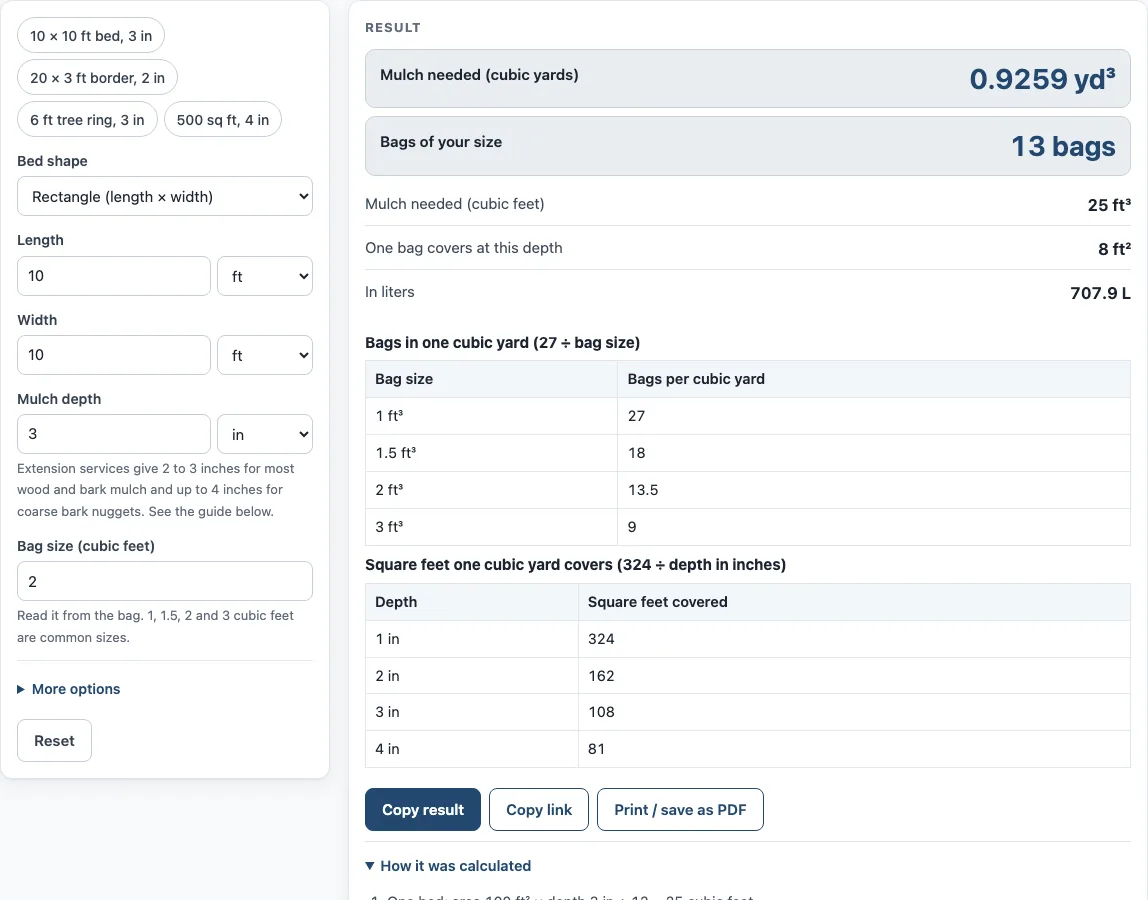
- Read the results: “Mulch needed (cubic yards)”, “Bags of your size” (rounded up), “Mulch needed (cubic feet)”, “In liters” and “One bag covers at this depth”. Two reference tables show bags per cubic yard and area per cubic yard at each depth.
- If you see an error, check that every size is a positive number. Warnings appear for a depth over 4 or 6 inches, a bag size under 0.1 or over 10 cubic feet, or an area over a million square feet.
A cost is your typed price multiplied by the number of bags, or by the cubic yards for bulk.
How many cubic feet are in a yard of mulch?
One cubic yard equals 27 cubic feet, because a yard is 3 feet long, 3 feet wide and 3 feet high (3 × 3 × 3 = 27). If you search for how many cubic feet in a yard of mulch, that is the answer. The results show cubic feet as well as cubic yards, so you can compare them with a bag label printed in cubic feet.
How is the mulch volume calculated?
The tool finds the area of your bed first, then multiplies it by the depth. For a rectangle, it uses length × width. For a circle, it uses π × (diameter ÷ 2)². For a triangle, it uses base × height ÷ 2. If you already know the area, it multiplies that number by the depth. The depth is converted to feet so the result comes out in cubic feet.
For example, a 10 ft × 10 ft bed at 3 inches has an area of 100 square feet. The depth is 0.25 feet, so the volume is 25 cubic feet. That is 0.9259 cubic yards. With 2 cubic foot bags, 25 ÷ 2 = 12.5, which rounds up to 13 bags.
How do I check the cubic yard number by hand?
The extension rule gives a quick check: square feet × depth in inches ÷ 324 equals cubic yards. The tool shows this rule as a check step under its own volume calculation. Clemson says one cubic yard covers 324 square feet at 1 inch deep. UF/IFAS says it covers 324 square feet at 1 inch or 108 square feet at 3 inches.
A fixed table shows the square feet one cubic yard covers at each depth: 324 at 1 inch, 162 at 2 inches, 108 at 3 inches and 81 at 4 inches. For the 100 square foot bed at 3 inches, 100 × 3 ÷ 324 = 0.9259 cubic yards, the same answer as above.
How many bags of mulch are in a yard?
Divide 27 by your bag size in cubic feet. A 1 cubic foot bag gives 27 bags per cubic yard. A 1.5 cubic foot bag gives 18. A 2 cubic foot bag gives 13.5. A 3 cubic foot bag gives 9. Bag sizes vary, and Texas A&M’s Travis County Extension lists 0.75, 1, 1.25 and 2 cubic foot bags, so always check the label on your bag. The tool rounds the bag count up, because you cannot buy part of a bag.
What depth of mulch should I use?
Depth is a value you type, and the tool does not choose one for you. UF/IFAS recommends mulching to 3 inches and no more, and only 1 inch around seedlings and small vegetables or herbs. It also advises replenishing mulch when the depth falls below 2 inches. Clemson gives no more than 2 to 3 inches for fine wood and bark mulch, up to 4 inches for coarse pine bark nuggets, and no more than 2 inches for grass clippings or shredded leaves. Rubber mulch has no cited depth, so none is preset. A depth over 4 inches triggers a warning, and a depth over 6 inches usually means a unit mix-up.
Does the tool add extra mulch for settling?
The extra percent for settling or waste is 0 by default. No source gives a figure for it, so the tool adds nothing unless you type a percent. If you have several identical beds, the number of beds multiplies the total before the bag count is rounded up.
Does a yard of mulch have a set weight?
The tool holds no weights. A weight appears only if you type a pounds-per-cubic-yard figure. No extension or government source with a pounds-per-cubic-yard figure for mulch was found, so none is preset. Check your supplier or the bag label for the weight of your material.
Sources (checked 15 October 2026): hgic.clemson.edu · gardeningsolutions.ifas.ufl.edu · travis-tx.tamu.edu
Worked examples
| Input | Result |
|---|---|
| 10 ft × 10 ft, 3 in deep | 25 cubic feet (0.9259 cubic yards), 13 bags of 2 cubic feet |
| 16 ft × 4 ft, 3 in deep | 16 cubic feet (0.5926 cubic yards), 8 bags of 2 cubic feet |
| round, 6 ft across, 2 in deep | 4.712 cubic feet (0.1745 cubic yards), 4 bags of 1.5 cubic feet |
| 500 ft², 4 in deep | 166.7 cubic feet (6.173 cubic yards), 84 bags of 2 cubic feet |
| triangle 3 m base, 2 m high, 7 cm deep | 7.416 cubic feet (0.2747 cubic yards), 3 bags of 3 cubic feet |
Calculated by the tool above; open it with the same values to see each step.
Frequently asked questions
How much mulch do I need for one bed?
Use the shape and size of the bed, plus the depth you want, and the calculator gives the total in cubic yards and bags. For a 10 ft × 10 ft bed at 3 inches, the result is 0.9259 cubic yards, or 13 bags of 2 cubic feet.
How many bags of mulch in a yard?
Divide 27 by the bag size in cubic feet. A yard holds 27 bags of 1 cubic foot, 18 bags of 1.5 cubic feet, 13.5 bags of 2 cubic feet, or 9 bags of 3 cubic feet. Check your bag label, because sizes vary.
How many bags of mulch on a pallet?
The tool does not list a pallet count. It works from the bag size you type. Ask your supplier how many bags are on a pallet, or check the product details for your mulch.
How much does a bag of mulch weigh?
The tool does not show bag weights. Look at the weight printed on the bag, or ask the supplier.
How much does a yard of mulch weigh?
The tool shows a weight only when you type a pounds-per-cubic-yard figure. It does not preset one, because no extension or government source with that figure for mulch was found.
How much is a yard of mulch?
The tool holds no prices. Type your price per cubic yard in bulk and the calculator multiplies it by the cubic yards needed. Type a price per bag and it multiplies that by the bag count.
How many cu ft in a yard of mulch?
A yard of mulch is 27 cu ft. This is the same as 27 cubic feet, and the tool uses it to convert between cubic yards and cubic feet.
Related tools
- Compost calculator: use it when you want to estimate how much compost a garden area needs.
- Lawn Area Calculator: use it to measure irregular beds as shapes and get one total area to type in here.
- Plant spacing calculator: use it to plan how many plants fit in the bed you are mulching.
- Mulch, Soil, Compost and Firewood: browse the full set of garden material calculators.
- Raised bed soil calculator: use it when you are filling a raised bed and need the soil volume.
- Topsoil calculator: use it when you are estimating how much topsoil a planting area needs.
- Landscaping Cost Calculator: Put the mulch into a whole-yard cost estimate.