
Landscaping Cost Calculator
Enter the size of the lawn, beds, patio and edging, then type the prices you were quoted. The page works out the mulch and soil you need and adds everything into a project total.
Recent
Your last 10 settings, saved only in this browser. Nothing is uploaded.
How to use the Landscaping Cost Calculator
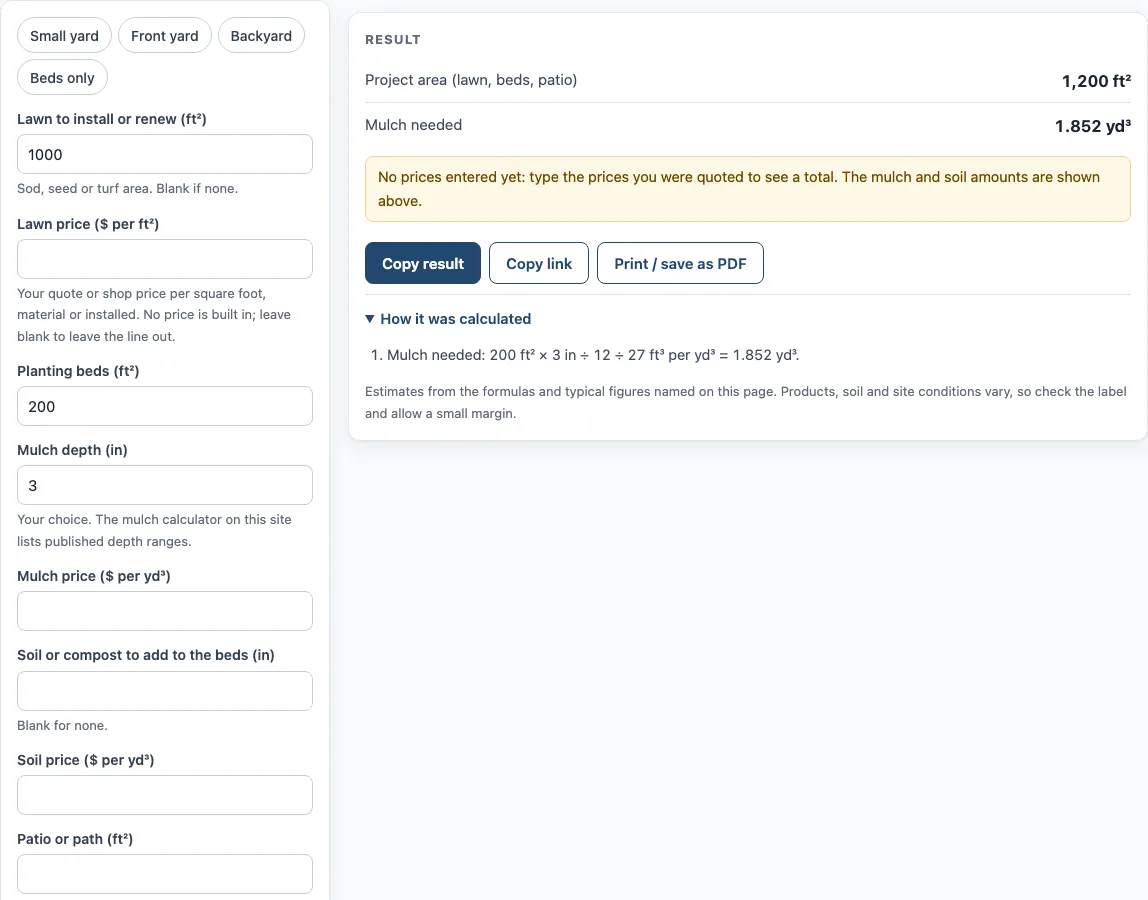
- Enter “Lawn to install or renew (ft²)” and “Lawn price ($ per ft²)” if the project includes sod, seed or turf. Four presets fill in typical yard sizes. Leave a line blank to leave it out.
- Enter “Planting beds (ft²)” and “Mulch depth (in)”, then “Mulch price ($ per yd³)”. To add soil or compost, fill in “Soil or compost to add to the beds (in)” and “Soil price ($ per yd³)”.
- Enter “Patio or path (ft²)” and “Patio or path price ($ per ft²)” for pavers, gravel or concrete at your own quote.
- Enter “Edging (ft)” with “Edging price ($ per ft)”, and “Plants, shrubs or trees (count)” with “Price per plant ($ each)”.
- Enter “Labor (hours)” and “Labor rate ($ per hour)”. Both are needed for the labor line.
- Under More options, add “Delivery, total ($)”, “Other costs, total ($)”, “Contingency (%)” and “Sales tax on materials (%)”.
- Read the result. “Mulch needed” and “Soil needed” appear without any price. “Total at your prices” and “Cost per square foot of project area” appear once you enter a price.
The presets fill in the lawn, bed and patio areas for a small yard, a front yard, a backyard or beds only, and you can change any number afterwards. A blank, negative or non-numeric value where a number is needed shows an error message instead of a result.
How are landscaping costs added up?
Each line is a quantity times your price. The total is: materials + sales tax on materials + labor + delivery + other costs, then the contingency percentage on that subtotal. The lawn, patio and edging lines use the area or length you enter. Plants use the count. The cost per square foot is the total divided by the lawn, bed and patio areas together.
Mulch and soil are bought by volume. The cubic yards are area × depth in inches ÷ 12 ÷ 27, because a cubic yard is 27 cubic feet. For example, 200 ft² of beds with 3 in of mulch needs 200 × 3 ÷ 12 ÷ 27 = 1.85 yd³. You choose the depth. The mulch calculator on this site lists the depth ranges that extension services publish.
For example, take 1,000 ft² of lawn at $1.50 per ft², those 200 ft² of beds mulched 3 in deep at $40 per yd³, 16 hours of labor at $35 and $60 delivery. The lawn is $1,500.00, the mulch $74.07 and the labor $560.00, so the subtotal is $2,194.07. A 10 % contingency adds $219.41, for a total of $2,413.48, or $2.01 per ft² over the 1,200 ft² of lawn and beds. These are test numbers to show the arithmetic. The page supplies no prices of its own.
Why add a contingency?
A contingency is a percentage of the subtotal you set aside for changes, such as extra soil or more labor hours. The page does not choose one for you. Type your own figure, or leave it blank. The cost per square foot is handy for comparing quotes of different sizes, but only when both quotes cover the same work.
Soil and mulch are separate lines because they go in different layers. A bed that gets both soil and mulch needs both depths entered.
Where do the prices come from?
From you: a quote from a landscaper, a price list from a garden center or a supplier, or your own hourly rate. If you do not have a price yet, leave the line blank and use the quantities to ask for one.
Worked examples
| Input | Result |
|---|---|
| 1,200 ft² project | 1.85 yd³ of mulch, no prices entered |
| 1,200 ft² project | total $2,413.48 |
| 270 ft² project | total $1,611.16 |
| 800 ft² project | total $1,680.00 |
Calculated by the tool above; open it with the same values to see each step.
Frequently asked questions
How much does landscaping cost?
This page does not show a typical cost. Enter the areas and the prices you were quoted to get a total for your own project.
How do I estimate landscaping costs for my yard?
Measure the lawn, beds and patio, choose a mulch depth, then enter your prices for each line. The page adds them and shows the cost per square foot of the project.
How much mulch do I need for my beds?
Bed area × depth in inches ÷ 12 ÷ 27 gives cubic yards. 200 ft² at 3 in is 1.85 yd³. Enter your own bed size and depth.
Does the calculator include labor?
Yes, if you enter hours and an hourly rate. Both are needed. You can also put a contractor’s quote in “Other costs, total ($)”.
What is the contingency for?
It adds a percentage to the subtotal for surprises. It is your own figure. Leave it blank to leave it out.
Can I use this to compare two landscaping quotes?
Yes. Enter the same areas for each quote and type that quote’s prices, then compare the totals and the cost per square foot of project area. Make sure both quotes include the same work.
Does it include permits, irrigation or lighting?
Not as separate lines. Put them in “Other costs, total ($)” at your own figure.
Is sales tax added to labor?
No. The tax percentage applies to the material lines only. Labor, delivery, other costs and the contingency are added after tax.
Related tools
- Mulch Calculator: Work out mulch by bed size and depth.
- Topsoil Calculator: Estimate soil for a bed or a lawn.
- Sod Calculator: Count sod rolls for a new lawn.
- Paver Patio Cost Calculator: Price a patio in more detail.
- Lawn Mowing Cost Calculator: Work out what keeping the lawn costs.
- Plant Spacing Calculator: See how many plants fit a bed.