
Grass Seed Calculator
Pick your grass and whether you are starting a lawn or overseeding, enter the area, and see pounds of seed and bags from published extension rates.
Recent
Your last 10 settings, saved only in this browser. Nothing is uploaded.
How to use the grass seed calculator
- Under “Grass”, choose your grass type: Kentucky bluegrass, tall fescue, perennial ryegrass, fine fescue, bermudagrass (common, seeded), zoysiagrass, centipedegrass or St. Augustinegrass. If you pick St. Augustinegrass, the tool points you to sod, since it is planted from sod or plugs.
- Under “Job”, pick “New lawn” or “Overseeding an existing lawn”. Overseeding rates exist only for Kentucky bluegrass, perennial ryegrass and tall fescue. For any other grass, the page shows an error unless you type your own rate in step 6.
- Under “Shape of the area”, choose rectangle, circle, triangle or a known total.
- Pick feet or meters under “Measure in” and enter the measurements. Check the area shown before you read the seed amount.
- Optional: enter “Seed bag size (lb)” to get the number of bags. It starts at 10 lb; clear it to skip bags. Bags are rounded up.
- Optional: enter “My own rate (lb per 1,000 ft²)” from your seed tag. It replaces the published range.
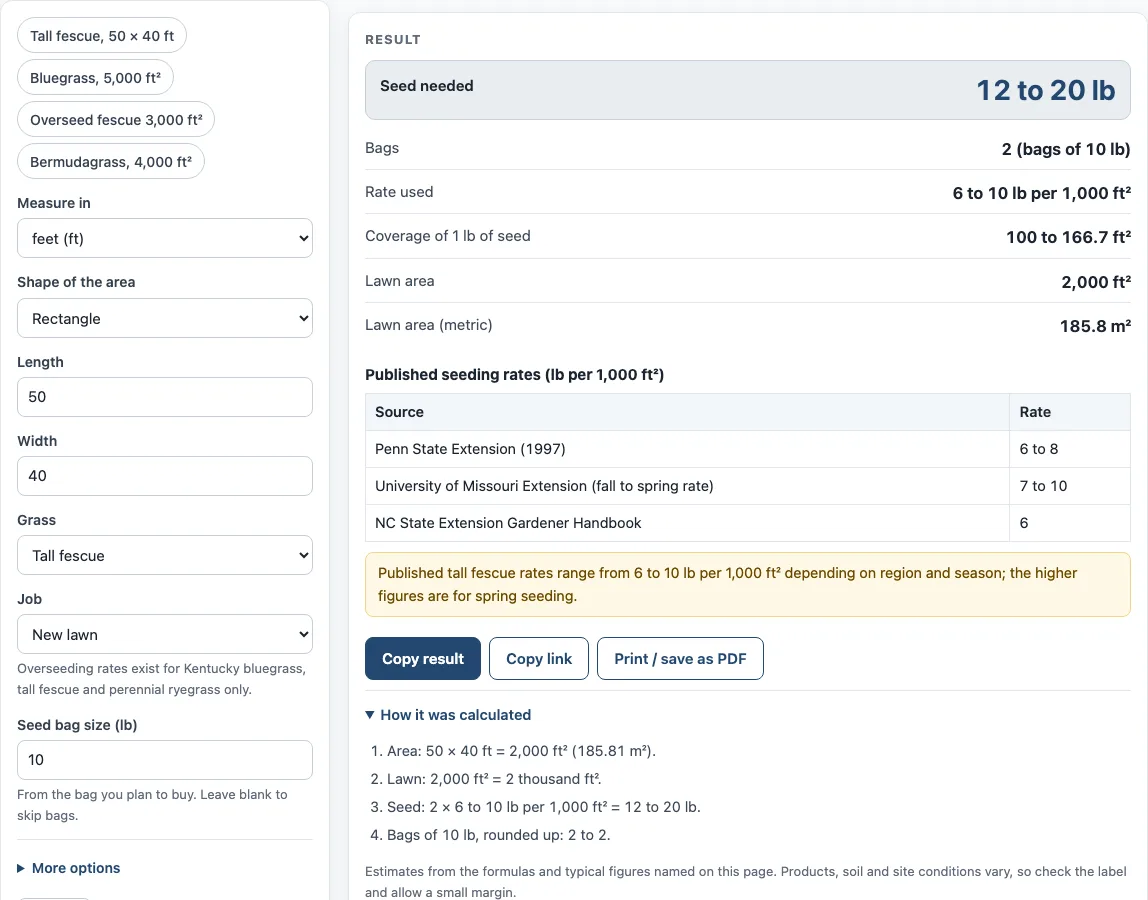
- Read the result. “Seed needed” gives the low and high pounds, “Bags” appears if you entered a bag size, “Rate used” shows the rate behind the figure, and “Coverage of 1 lb of seed” shows the area one pound covers.
The rate table on the page lists what each named source gives for your chosen grass,. The table is hidden when you type your own rate.
How is grass seed calculated from lawn area?
Seed in pounds equals your area divided by 1,000, then multiplied by the rate. The rate is the pounds of seed per 1,000 square feet, so the tool divides your area by 1,000 and multiplies that number by the low and high rates.
For example, a 50 by 40 foot lawn is 2,000 square feet. Divide 2,000 by 1,000 to get 2. Tall fescue as a new lawn is 6 to 10 pounds per 1,000 square feet, so 2 times 6 gives 12 pounds, and 2 times 10 gives 20 pounds. That is 12 to 20 pounds of seed, or 2 bags of 10 pounds. A bag size you enter tells the tool how many bags to show.
Kentucky bluegrass works the same way. A 5,000 square foot lawn at 1.5 to 3 pounds per 1,000 square feet needs 7.5 to 15 pounds, so one 25 pound bag covers it at either end of the range. The seed bag you buy sets the bag size, so enter the weight printed on your bag.
Why does the seed rate come as a range?
The named extension sources do not give one identical rate for each grass, so the tool shows the lowest and highest figure among them. The table on the page lists each source’s rate for the grass you chose, and the range is built from those numbers.
Some examples show how this works. For tall fescue as a new lawn, Penn State gives 6 to 8, NC State gives 6 and Missouri gives 7 to 10, so the range shown is 6 to 10. The range is wide because the higher figures are for spring seeding. For perennial ryegrass as a new lawn, Penn State gives 4 to 5 and Missouri gives 7 to 10, so the range shown is 4 to 10. For bermudagrass, NC State gives 1 to 2 and the UF/IFAS table gives 1 to 4, though its text says 1 to 2 for hulled seed, so the range shown is 1 to 4.
The overseeding rates come from a different table. Cornell University’s quick-cover sports field table gives rates at or above the new-lawn figures for tall fescue and perennial ryegrass, because it is written for quick cover on sports fields. The page warns that a thin lawn that only needs thickening may need less. Use these numbers as a reference for your own calculation, not as a guarantee of results.
Sources (checked 15 October 2026): extension.psu.edu · extension.missouri.edu · content.ces.ncsu.edu · edis.ifas.ufl.edu · safesportsfields.cals.cornell.edu
Worked examples
| Input | Result |
|---|---|
| 2,000 ft² of Tall fescue, New lawn | 12 to 20 lb |
| 5,000 ft² of Kentucky bluegrass, New lawn | 7.5 to 15 lb |
| 3,000 ft² of Perennial ryegrass, Overseeding an existing lawn | 30 to 45 lb |
| 706.9 ft² of Bermudagrass (common, seeded), New lawn | 0.7069 to 2.827 lb |
| 3,229 ft² of Centipedegrass, New lawn | 0.8073 to 3.229 lb |
Calculated by the tool above; open it with the same values to see each step.
Frequently asked questions
How much grass seed per square foot do I need?
Divide the rate per 1,000 square feet by 1,000. Tall fescue at 6 to 10 pounds per 1,000 square feet is 0.006 to 0.01 pounds per square foot. The calculator does this division for you when you enter your area.
How much grass seed per acre?
One acre is 43,560 square feet, so multiply the rate per 1,000 square feet by 43.56. For tall fescue at 6 to 10 pounds, that is about 261 to 436 pounds per acre. To check a whole acre, choose “Total area (already known)” and enter 43,560.
How much grass seed do I need for overseeding?
Overseeding rates are available for Kentucky bluegrass at 2.5 to 3.5 pounds, perennial ryegrass at 10 to 15 pounds and tall fescue at 10 to 15 pounds per 1,000 square feet. For example, overseeding 3,000 square feet with perennial ryegrass is 30 to 45 pounds. These rates come from a table written for quick cover on sports fields.
What is the grass seed cost?
The calculator does not show prices. It gives pounds of seed and, if you enter a bag size, the number of bags. To estimate cost, multiply the bag count by the price you find for your bag.
Can I calculate seed for St. Augustinegrass?
No. Extension guides say St. Augustinegrass is not sold as seed, so the tool shows a message pointing you to sod instead of a rate. The Sod Calculator can help you work out how much sod to order instead.
What does my own rate do?
Enter the rate from your seed tag in “My own rate (lb per 1,000 ft²)”, and it replaces the published range. This is useful when your product label gives a rate you want to use. The tool then calculates the pounds and bags from that rate.
Related tools
- Lawn Area Calculator: use it to find the square footage of your lawn before you enter it here.
- Sod Calculator: use it if you are choosing sod instead of seed, including for St. Augustinegrass.
- Artificial Turf Installation Cost Calculator: use it if you are weighing artificial turf as an alternative to growing grass.
- Topsoil Calculator: use it to size the topsoil layer under a new seeded lawn.
- Compost Calculator: use it to work out compost to mix into the soil before seeding.
- Mulch Calculator: use it for the beds around the lawn edge.
- Paver and Lawn Calculators: browse the full set of patio and lawn tools.