
Deck Ledger Board
Enter the joist span, the fastener and the house band joist to read the fastener spacing the AWC deck guide gives for a ledger, with the ledger size and fastener rules.
Recent
Your last 10 settings, saved only in this browser. Nothing is uploaded.
How to use the Deck Ledger Board tool
- Type a number into “Joist span (deck joists, house to beam)”. This is the distance the deck joists cover from the house to the beam. Choose the unit: in, ft, cm or m.
- Open “Fastener” and choose 1/2 in lag screw, 1/2 in bolt, or 1/2 in bolt with 1/2 in stacked washers.
- Open “House band or rim joist” and choose 1-1/2 in solid lumber, 1-1/8 in LVL, or 1 in LVL.
- Optionally, type a length into “Ledger length (optional)”. Leave it blank if you only need the spacing.
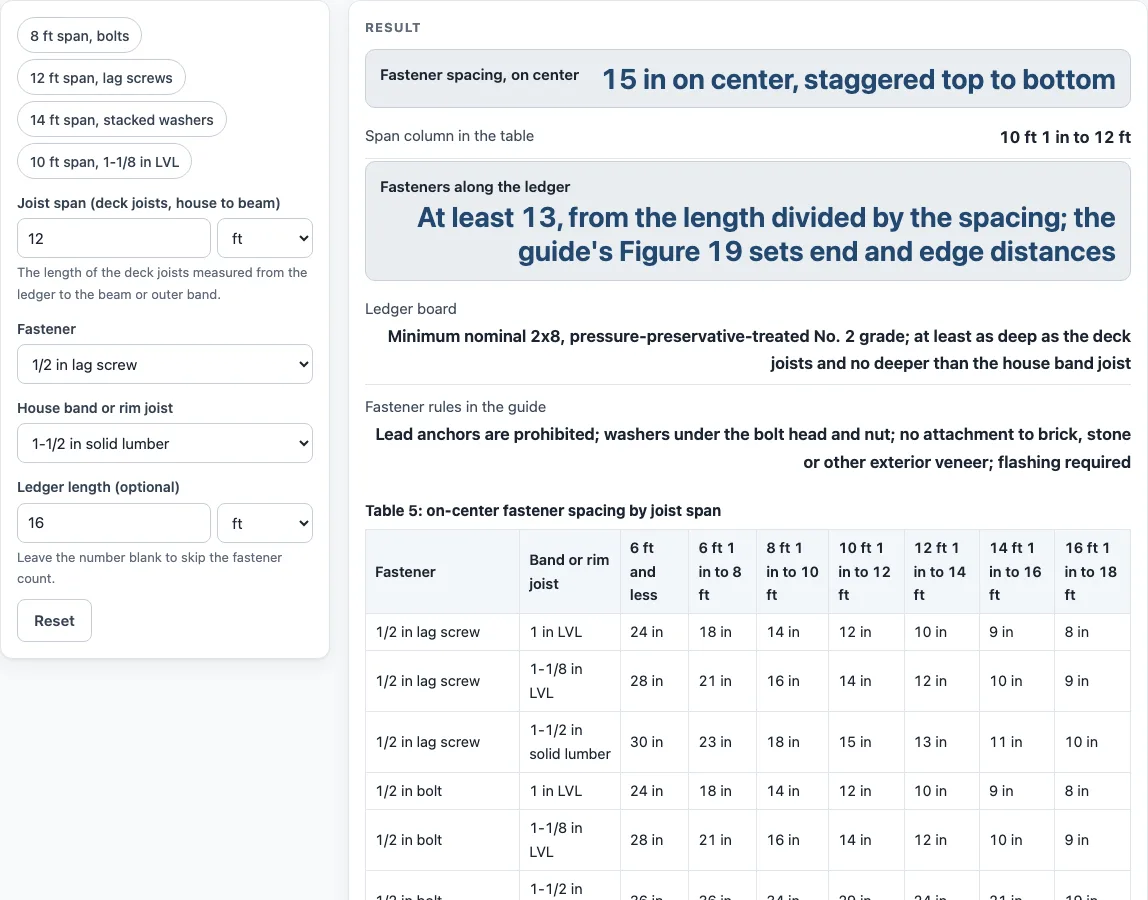
- Read “Fastener spacing, on center”. This is the value from Table 5 for your span and connection.
- Check “Span column in the table” to see which span range your joist span falls into.
- If you typed a ledger length, read “Fasteners along the ledger”. The count is the ledger length divided by the spacing, rounded up.
- Read “Ledger board” and “Fastener rules in the guide” for the ledger requirements that apply to your choice.
- Scroll to “Table 5: on-center fastener spacing by joist span” to compare all seven connection rows across the seven span columns.
The four presets fill the controls for you: 8 ft span with bolts, 12 ft span with lag screws, 14 ft span with stacked washers, and 10 ft span with 1-1/8 in LVL. Use a preset as a starting point, then change any control to match your deck. A blank, zero or non-numeric span shows an error, and so does a span over 18 ft, which is outside the table.
What rules apply to a deck ledger board?
A deck ledger board is the board that carries one side of the deck against the house, so the guide sets limits on it before any fastener spacing is checked. The rules below come from the American Wood Council deck guide DCA 6 (2015), which this page quotes.
The ledger must be a minimum nominal 2x8, pressure-preservative-treated No. 2 grade. It must be at least as deep as the deck joists and no deeper than the house band or rim joist. A band joist thinner than 1 in needs a non-ledger deck or a full plan.
The ledger cannot attach to brick, masonry or stone veneer. Lead anchors are prohibited, flashing is required, and through-bolt pilot holes should be 17/32 to 9/16 in, with washers at the head and nut.
Table 5 assumes a deck live load of 40 psf, a dead load of 10 psf, and a pressure-treated ledger of Southern Pine, Douglas Fir-Larch or Hem-Fir. Lag screws and bolts are staggered top to bottom, and the tip of a lag screw must pass fully through the band or rim joist. Stacked washers are not permitted with gypsum board or foam sheathing. If your house differs from these details, a non-ledger deck or a full plan submission is needed, and this page does not cover that case.
How is ledger fastener spacing calculated?
The tool finds the Table 5 column that holds your joist span, then reads the spacing for your fastener and band. The seven span columns are 6 ft and less, 6 ft 1 in to 8 ft, 8 ft 1 in to 10 ft, 10 ft 1 in to 12 ft, 12 ft 1 in to 14 ft, 14 ft 1 in to 16 ft, and 16 ft 1 in to 18 ft.
For 1-1/2 in solid lumber, a 1/2 in lag screw gives 30, 23, 18, 15, 13, 11 and 10 in on center across those columns. A 1/2 in bolt gives 36, 36, 34, 29, 24, 21 and 19 in. A 1/2 in bolt with 1/2 in stacked washers gives 36, 36, 29, 24, 21, 18 and 16 in. LVL values are 28, 21, 16, 14, 12, 10 and 9 in for 1-1/8 in LVL, and 24, 18, 14, 12, 10, 9 and 8 in for 1 in LVL. Lag screws and bolts give the same LVL values, and the guide has no stacked-washer row for LVL.
For example, a 12 ft span with a 1/2 in lag screw into 1-1/2 in lumber falls in the 10 ft 1 in to 12 ft column and gives 15 in on center. For a 16 ft ledger, 192 in divided by 15 in is 12.8, which rounds up to 13 fasteners.
The count is a quick calculation, not a full layout. The guide’s Figure 19 sets end and edge distances, which this page does not reproduce, so check those distances before you mark your holes.
Sources (checked 19 October 2026): web-media.awc.org
Worked examples
| Input | Result |
|---|---|
| 12 ft joist span, 1/2 in lag screw, 1-1/2 in solid lumber | 15 in on center |
| 9 ft joist span, 1/2 in bolt, 1-1/2 in solid lumber | 34 in on center |
| 16 ft joist span, 1/2 in bolt with 1/2 in stacked washers, 1-1/2 in solid lumber | 18 in on center |
| 6 ft joist span, 1/2 in lag screw, 1-1/8 in LVL | 28 in on center |
Calculated by the tool above; open it with the same values to see each step.
Frequently asked questions
Can I use a span over 18 ft?
No. Spans over 18 ft are outside Table 5, so the tool shows an error instead of a spacing.
Does a result mean my deck is safe?
The result is calculated from your inputs and quotes Table 5 of the guide. It is not an engineering design and does not check your house, so it cannot confirm that your deck is safe.
Why does LVL with stacked washers show an error?
The guide has no stacked-washer row for LVL. Choose a 1/2 in lag screw or 1/2 in bolt for an LVL band instead.
What does the LVL warning about 300 lb or 350 lb mean?
The LVL values are based on 300 lb per fastener for 1 in LVL and 350 lb per fastener for 1-1/8 in LVL. The warning appears so you can see that basis for the numbers.
Why is my fastener count different from my plan?
The count divides the ledger length by the spacing and rounds up. The guide’s end and edge distances from Figure 19 are not reproduced here, so the count does not show final positions.
What if my house band joist is thinner than 1 in?
A band joist thinner than 1 in needs a non-ledger deck or a full plan. The tool does not give a spacing for that case.
Related tools
- Deck Board Calculator: use it when you are planning the decking boards on the surface of the deck.
- Deck Board Dimensions: use it to compare the sizes of deck boards before you choose one.
- Cost to Build a Deck Calculator: use it when you are planning the budget for building the deck.
- Deck Footing Calculator: use it when you are working out the footings that support the deck’s beams.
- Deck Joist Spacing Chart: use it when you are checking how far apart the deck joists sit.
- Deck Railing Height: use it when you are planning the height of the deck railing.
- Deck Stain Calculator: use it when you are planning how much stain the deck needs.
- Sonotube Sizes: use it when you are comparing the sizes of round concrete form tubes for footings.