
Above Ground Pool Sizes
Enter the pool shape, its size and how deep the water will be to get gallons, liters and surface area, with one maker's published capacities for comparison.
Recent
Your last 10 settings, saved only in this browser. Nothing is uploaded.
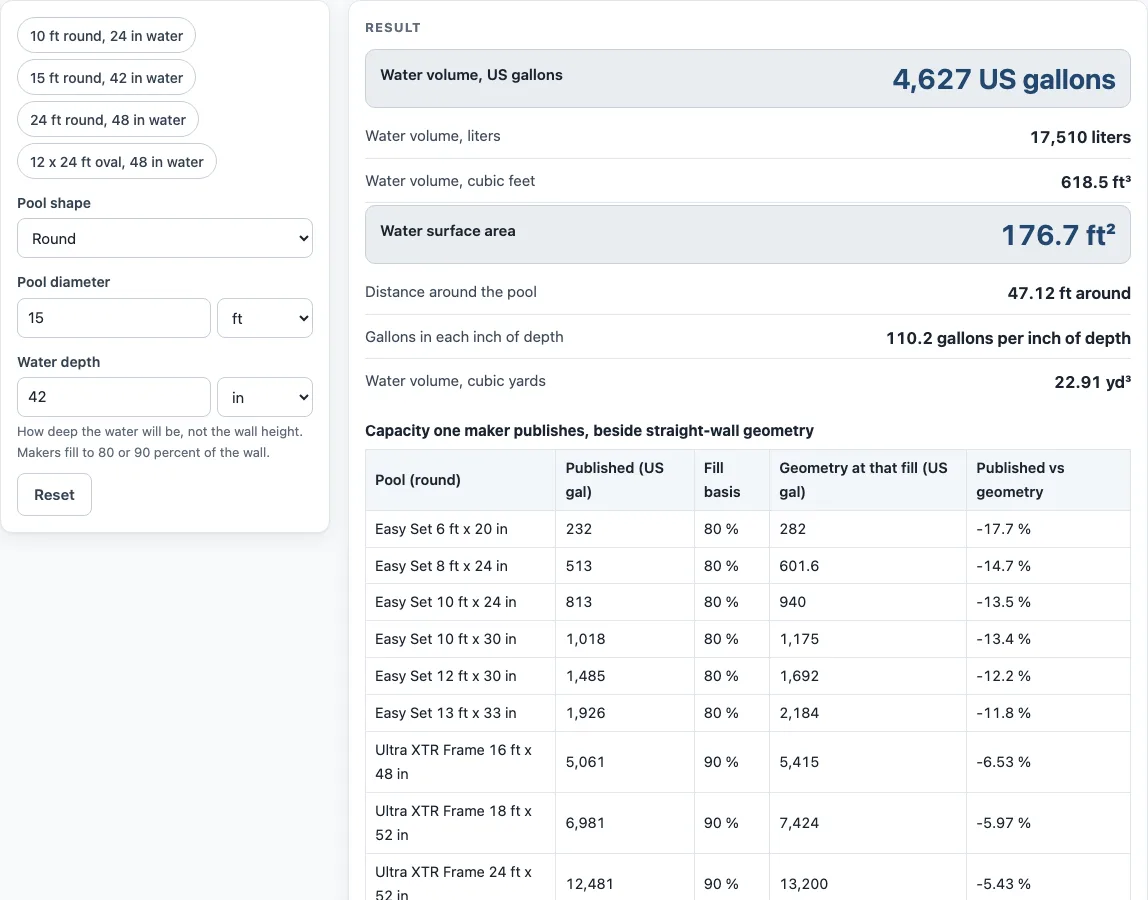
How to use this pool size tool
- Choose a “Pool shape”: Round, Oval or Rectangle.
- For a round pool, type the “Pool diameter”. For an oval or rectangle, type the “Pool length” and “Pool width”.
- Pick the unit for each size: ft, in, m or cm.
- Type the “Water depth” and pick its unit: in, ft, cm or m.
- Read the water volume in “Water volume, US gallons”, “Water volume, liters” and “Water volume, cubic feet”. For more detail, check “Water volume, cubic yards” and “Gallons in each inch of depth”.
- Check “Water surface area” and “Distance around the pool”, which is shown for round and rectangle pools.
- Compare the table “Capacity one maker publishes, beside straight-wall geometry”. The two figures can differ.
- Scan the table “Round pools at your … in of water” to see diameters from 8 to 30 ft at the depth you entered.
- Read any warning. The tool warns when width is longer than length (rectangle and oval), when water is deeper than 6 ft, and it shows a note for ovals. Blank, zero or non-numeric sizes show an error, so correct the entry before reading the results.
The four presets give you a starting point: a 10 ft round pool with 24 in of water, a 15 ft round pool with 42 in, a 24 ft round pool with 48 in, and a 12 x 24 ft oval with 48 in. Choose one to see how the controls fill in, then change the numbers to match your own pool.
How large are above ground pool sizes in the published range?
The maker’s product pages list round pools from 6 ft with 20 in of water up to 24 ft with 52 in of water. The listed round sizes are 6, 8, 10, 12, 13, 16, 18 and 24 ft, with depths from 20 in to 52 in. The tool’s second table covers round diameters from 8 to 30 ft, so it reaches past the largest listed size.
Sizes vary by maker, so a pool with the same diameter from another maker may hold a different amount of water. The maker’s chart says its capacities are calculated at 90 percent for frame pools and 80 percent for its Easy Set and oval pools. That share is the maker’s own calculation, not a rule for every pool.
How is the water volume of an above ground pool worked out?
The tool finds the water surface area first, then multiplies it by the water depth. For a round pool, the area is pi x (d/2)², where d is the diameter. For an oval, the area is pi/4 x length x width, which is the ellipse formula. For a rectangle, the area is length x width. In each case, volume = area x water depth.
Cubic feet become US gallons by multiplying by 1,728 and dividing by 231, which gives 7.4805 gallons per cubic foot, because the US gallon is exactly 231 cubic inches. Liters equal gallons multiplied by 3.785411784.
The default example is a 15 ft round pool with 42 in (3.5 ft) of water. Its surface is 176.7 ft², and it holds 618.5 ft³, which is 4,626.7 US gallons or 17,514 liters. The distance around it is 47.12 ft. A 10 ft round pool with 24 in of water holds 157.1 ft³, or 1,175 gallons.
For an oval, a 24 x 12 ft pool with 48 in of water has a surface of 226.2 ft² and holds 904.8 ft³, or 6,768 gallons by the ellipse formula. For a rectangle, a 16 x 32 ft pool with 4 ft of water holds 2,048 ft³, or 15,320 gallons.
Sources (checked 19 October 2026): intexcorp.com · intexcorp.com · intexcorp.com · intexcorp.com · intexcorp.com
Worked examples
| Input | Result |
|---|---|
| 15 ft round pool, 42 in of water | 4,627 US gallons (618.5 ft³) |
| 24 x 12 ft pool, 48 in of water | 6,768 US gallons (904.8 ft³) |
| 16 x 32 ft pool, 48 in of water | 15,320 US gallons (2,048 ft³) |
| 14.993 ft round pool, 39.37 in of water | 4,333 US gallons (579.3 ft³) |
Calculated by the tool above; open it with the same values to see each step.
Frequently asked questions
Why do the published capacity and the straight-wall figure differ?
The table works out straight-wall geometry at the same share of wall height the maker uses. These pools are not straight-walled cylinders, so the two figures differ. In the table the published figure is 5 to 18 percent lower than the straight-wall figure. For the 10 ft x 30 in Easy Set, the published figure is 1,018 gallons, which is 13.4 percent lower than the 1,175 gallons from straight-wall geometry.
Does a result mean the pool is safe or code compliant?
No. The tool calculates volume and size from the numbers you enter. It does not check safety or building codes, so use the pool’s manual and your local rules for those questions.
Why does the 24 ft frame pool page show 22 ft?
The maker’s 24 ft x 52 in frame pool page prints “22Ft X 52In” in its product-size field, while the title and set-up size say 24 ft. The table keeps the 24 ft title.
How accurate are oval results?
The oval figure is an ellipse, so it is an estimate. A warning on the page says real ovals can hold less.
Why does a warning appear when water is deeper than 6 ft?
The tool shows a warning when water is deeper than 6 ft. Check the “Water depth” unit and value, because a wrong unit changes the result a great deal.
Does the tool upload my pool measurements?
No. Everything runs in your browser, nothing is uploaded, and there is no sign-up. The tool is free.
Related tools
- Hot Tub Dimensions: use it to compare a hot tub’s footprint with the space a pool takes up.
- Landscaping Cost Calculator: use it when you are planning the cost of work around a pool area.
- Patio umbrella size chart and calculator: use it to choose shade for a patio near the pool.
- Pergola cost calculator: use it when you are estimating the cost of a pergola beside a pool.
- Trampoline Sizes: use it to compare a trampoline’s size with a pool’s footprint.